LLMjacking: The $100K/Day AI Attack Draining Company Budgets
NovaEdge Digital Labs
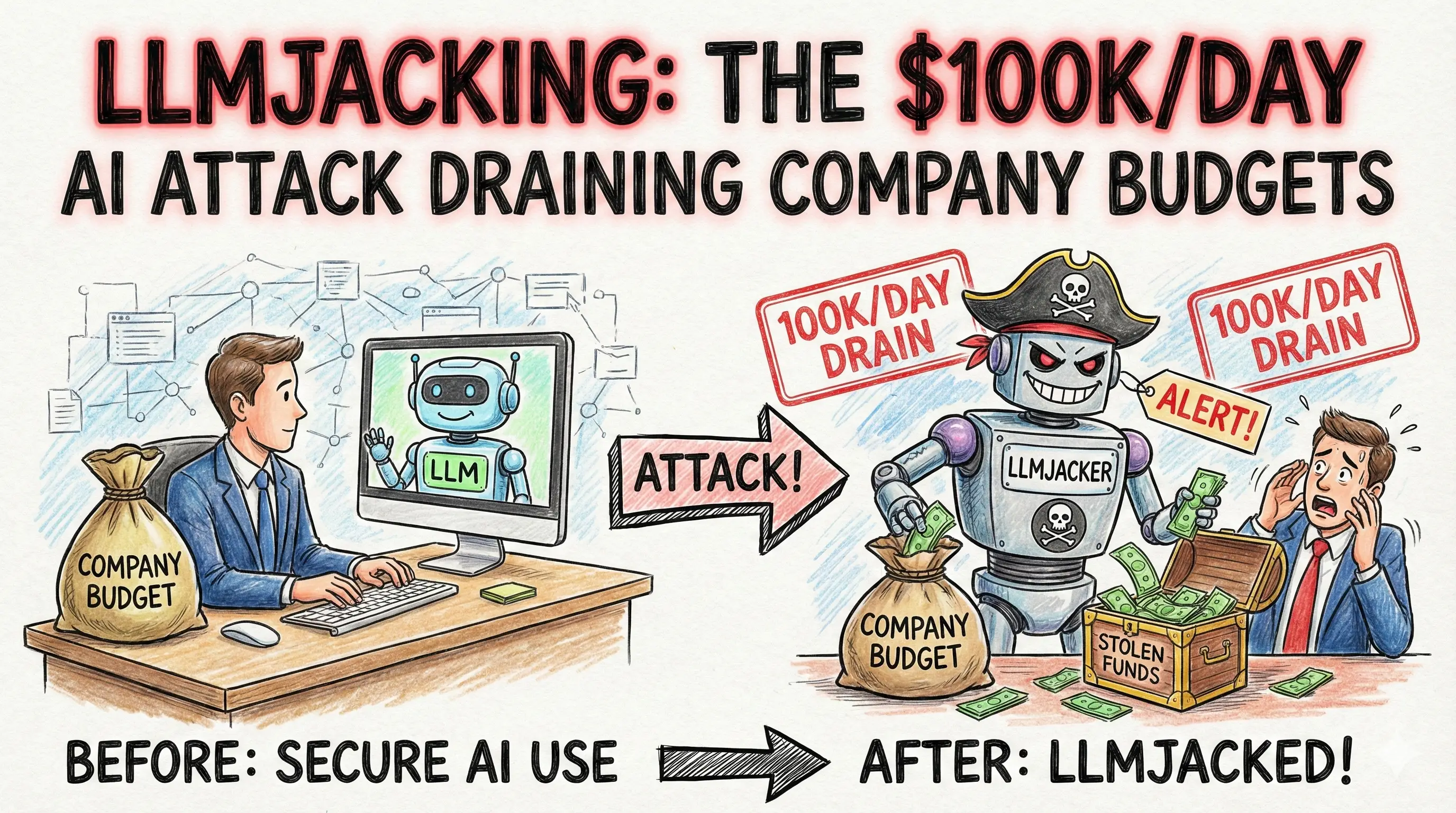
The fastest-growing cybersecurity threat of 2026 is costing companies $46,000-$100,000 per day in stolen AI compute. Complete guide to detection, prevention, and response to LLMjacking attacks targeting OpenAI, Claude, AWS Bedrock, and other LLM services.
Your company's AI bill just went from $8,000 to $87,000. Overnight.
You didn't approve any new projects. You didn't scale up. Your team didn't change anything.
But someone is using your AI—and it's not you.
Welcome to LLMjacking: the fastest-growing cybersecurity threat of 2026, and it's costing companies $46,000 to $100,000 per day in stolen AI compute resources.
If you're using OpenAI, Claude, AWS Bedrock, Google AI, or any cloud-based LLM service—and you haven't secured your API credentials—you're vulnerable right now.
This isn't theoretical. It's happening to companies every single day.
Here's what you need to know, and more importantly, what you need to do today to protect yourself.
The Wake-Up Call
March 2026. A mid-sized SaaS company in Austin.
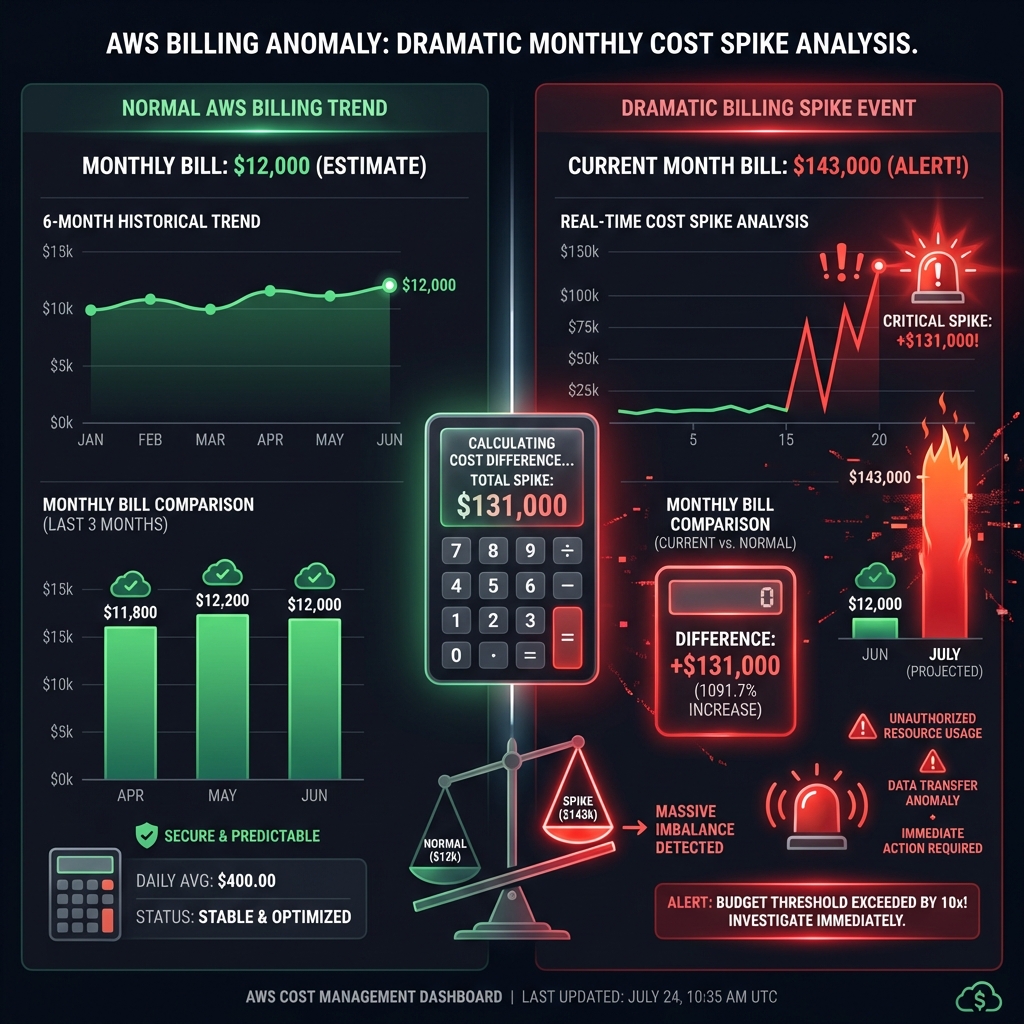
The CFO opens the monthly AWS bill.
Expected: $12,000 Actual: $143,000
"There must be a mistake," she thinks.
But there's no mistake.
Their AWS Bedrock account—used to power their AI customer service chatbot—had been compromised. For 3 weeks, attackers used their credentials to run massive AI workloads.
The breakdown:
- 847 million tokens processed
- 24/7 usage (their normal pattern: 9 AM - 6 PM weekdays)
- Geographic origin: Eastern Europe, Southeast Asia, Brazil
- Models used: Claude Opus (most expensive tier)
Their normal usage: Claude Haiku (cheapest tier), ~20 million tokens/month
The attacker's usage: Claude Opus, ~280 million tokens/week
Total unauthorized charges: $131,000
AWS's response: "The API calls were made with valid credentials. Payment is due."
No refund. No forgiveness. Pure loss.
This company isn't alone.
Sysdig's 2026 Threat Research Report documents LLMjacking as the fastest-growing attack vector in cloud security, with:
- 376% increase in credential theft targeting AI services (Q4 2025 vs Q1 2026)
- Average attack duration: 17 days before detection
- Average daily cost: $46,000 to $100,000
- Refund success rate: Less than 5%
Translation: Most companies lose every penny.
Why is this happening now?
Three converging factors:
1. AI Adoption Explosion
- Companies rushed to implement AI in 2024-2025
- Security was an afterthought ("let's just get it working first")
- Credentials scattered across repos, servers, developer machines
- No one mapped where all the API keys live
2. High-Value Target
- AI compute is expensive (Claude Opus: ~$15 per 1M tokens)
- Perfect for resale (Underground marketplaces thrive)
- Difficult to detect (looks like normal usage)
- Providers don't refund (pure profit for attackers)
3. Low Security Barrier
- Most companies use basic API keys (just a string)
- No MFA for API access
- No IP restrictions
- No spending limits
- No anomaly detection
- "Set it and forget it" mentality
The result: A perfect storm.
Attackers have figured out this equation:
Stolen AI Credentials = Unlimited Compute = Massive Profit = Low Risk
And they're exploiting it aggressively.
What is LLMjacking?
LLMjacking = LLM + Hijacking
Simple definition: Attackers steal your AI service credentials (API keys, access tokens, service accounts) and use them to run their own AI workloads on your account—leaving you with the bill.
Technical definition: Unauthorized access and abuse of Large Language Model (LLM) API credentials to consume compute resources for purposes unrelated to the legitimate account holder, resulting in financial loss through fraudulent billing.
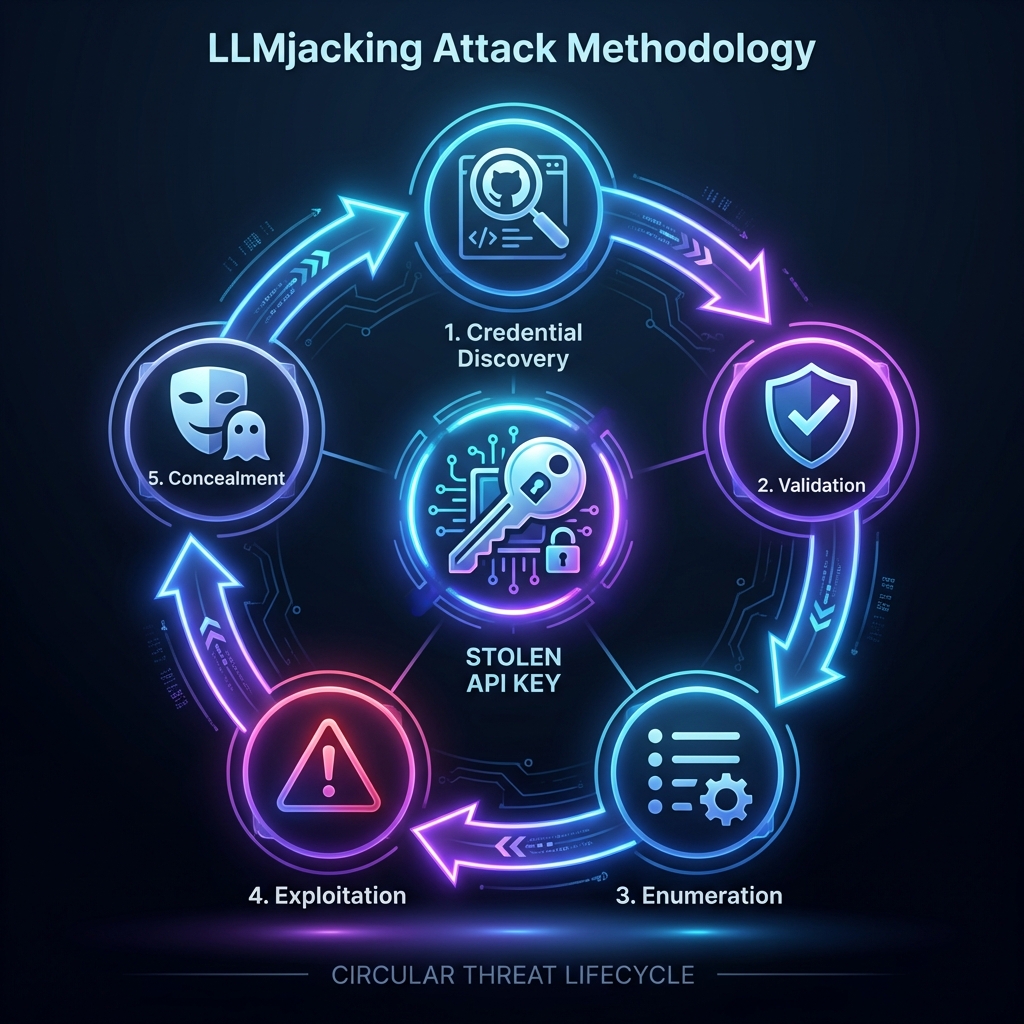
How it works (5-step attack):
Step 1: Credential Discovery Attacker finds your API key through:
- GitHub commits (searching for exposed secrets)
- Data breaches (credentials in leaked databases)
- Phishing (tricking employees)
- Insider threats (malicious or careless employees)
- Supply chain compromises (third-party tools breached)
Step 2: Validation Attacker tests if the credential still works.
Step 3: Enumeration Attacker determines:
- What permissions does this key have?
- What spending limits exist (if any)?
- What models are accessible?
- Current usage patterns (to blend in)
Step 4: Exploitation Attacker uses credentials for:
- Resale (sell access on underground marketplaces)
- Personal use (run their own AI projects on your dime)
- Crypto mining alternative (AI compute as profitable as crypto)
- Competitive intelligence (if they're your competitor)
- Training their own models (using your expensive GPUs)
Step 5: Concealment Sophisticated attackers:
- Mimic your usage patterns (same times, similar volumes)
- Use VPNs matching your geography
- Gradually ramp up (avoid sudden spikes)
- Stay under monitoring thresholds (if you have any)
- Cover tracks (if they have administrative access)
The economics that make this attractive:
- Cost to attacker: $0 (they stole the credentials)
- Value generated: $50K-$100K/month (reselling access or using for own projects)
- Risk of getting caught: Low (most companies don't monitor well)
- Penalty if caught: Low (mostly civil, not criminal in most jurisdictions)
For attackers, this is easy money.
Real Attack Scenarios
Let's look at how this actually happens to real companies.
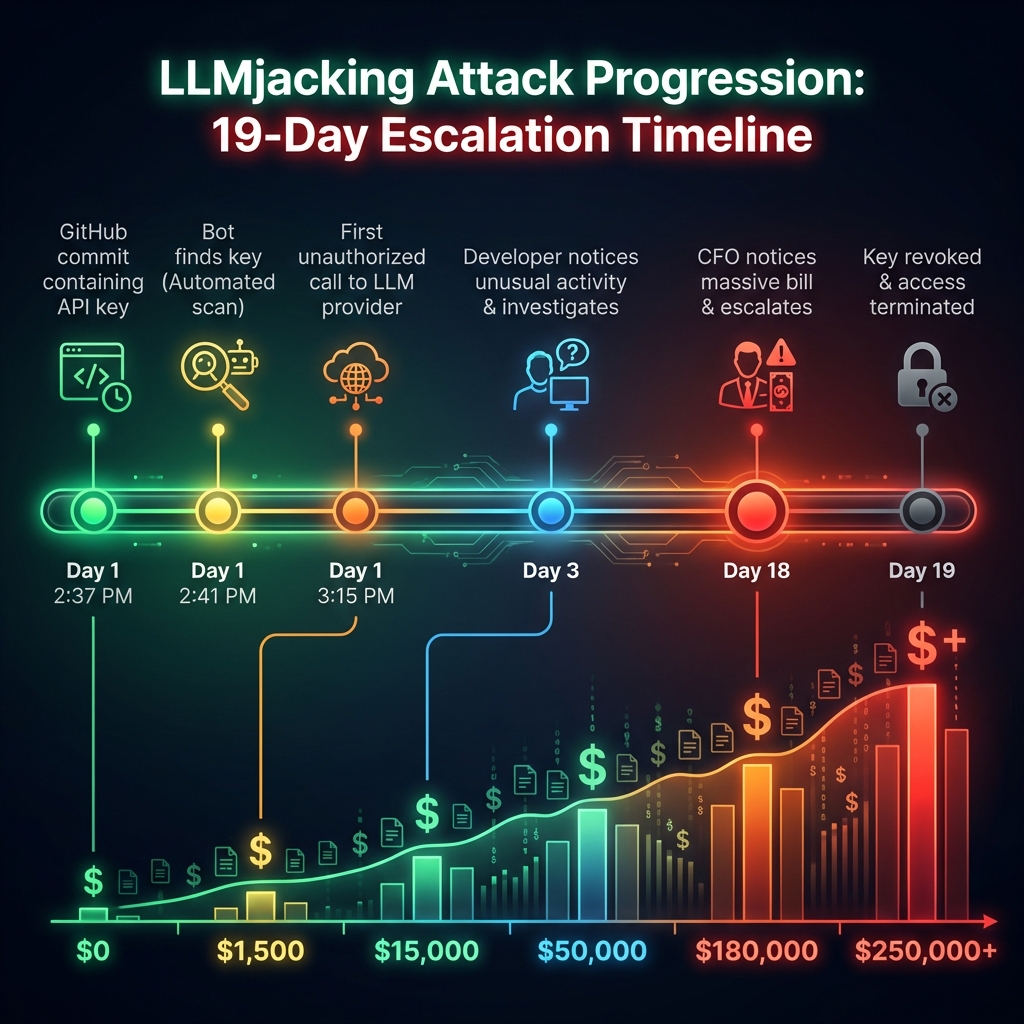
Scenario 1: The GitHub Commit
Company: Series B fintech startup, 50 employees Date: January 2026 Cost: $73,000
What happened:
Junior developer commits code to public GitHub repo with hardcoded API key.
Timeline:
- Day 1, 2:37 PM: Commit pushed to GitHub
- Day 1, 2:41 PM: Automated bot scrapes GitHub, finds key
- Day 1, 2:43 PM: Key validated, added to marketplace
- Day 1, 3:15 PM: First unauthorized API call
- Day 3: Developer realizes mistake, removes from GitHub (but attacker already has the key)
- Day 18: CFO notices unusual bill
- Day 19: Key finally revoked
Total damage: 1.2 billion tokens, $73,000
Root cause: Hardcoded credential in source code Detection time: 18 days Refund from OpenAI: $0
Scenario 2: The Phishing Email
Company: Healthcare AI analytics firm Date: February 2026 Cost: $127,000
DevOps engineer receives fake AWS email with perfect replica login page. Engineer enters credentials.
Timeline:
- Day 1: Credentials stolen via phishing
- Day 1, +2 hours: Attacker accesses AWS account
- Day 1, +3 hours: Creates new IAM access keys (leaves original intact)
- Day 1, +4 hours: Begins AWS Bedrock usage (Claude Opus)
- Day 11: Security team notices large AWS bill
- Day 13: Compromised credentials identified and revoked
Total damage: $127,000 in Bedrock charges
Root cause: Successful phishing attack + no MFA on AWS console Detection time: 11 days Refund from AWS: $0 (AWS's position: "Valid credentials were used")
Scenario 3: The CI/CD Pipeline
Company: E-commerce platform Date: March 2026 Cost: $91,000
API keys stored in CircleCI from 2023 breach. Keys never rotated. Attacker uses 2+ year old credential that still works.
Total damage: $91,000
Root cause: - API key stored in third-party service - Never rotated (key was 2+ years old) - Company didn't know CircleCI had been breached
Common Patterns:
- • Detection took 11-21 days (average: 17 days)
- • No refunds (cloud providers refused all refund requests)
- • Attackers used most expensive models (maximize profit)
- • 24/7 usage (attackers don't sleep, unlike legitimate users)
- • Geographic anomalies (calls from unexpected countries)
- • Companies had NO monitoring (discovered only via bill)
- • Simple preventive measures could have stopped them
Could This Happen to You?
Companies just like yours are losing $46,000+ per day to LLMjacking. Don't wait for a six-figure surprise bill.
NovaEdge Digital Labs offers free security assessments to help you identify vulnerabilities before attackers do.Get a Free Security Assessment
The Underground Marketplace
LLMjacking isn't just opportunistic—it's a thriving underground economy.
Where stolen credentials are sold:
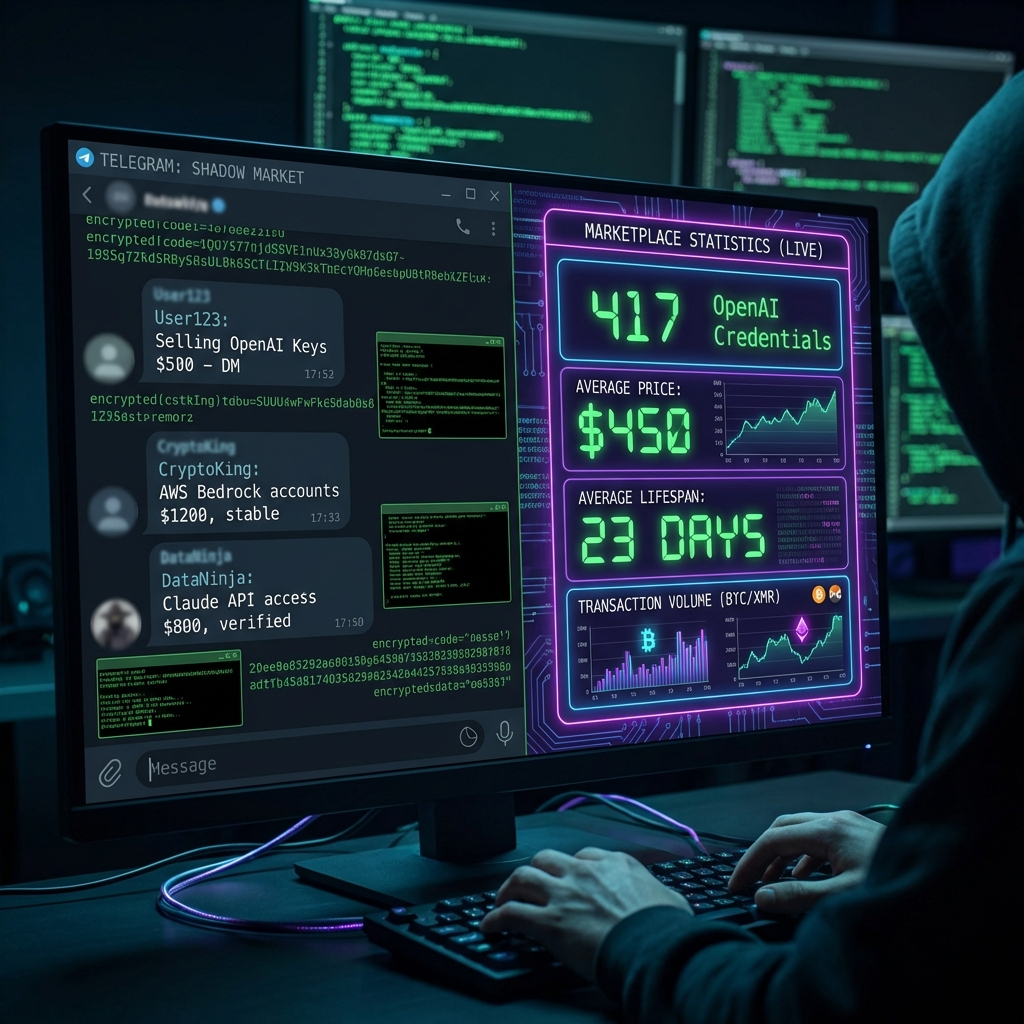
Marketplace 1: Telegram Channels
Popular channels (names anonymized):
- "AI Access Hub" (42,000 members)
- "LLM Keys Market" (28,000 members)
- "Cloud Compute Trades" (19,000 members)
What's sold:
- OpenAI API keys: $200-$800 depending on spending limit
- Anthropic Claude keys: $300-$1,000
- AWS Bedrock access: $500-$2,000
- Google AI access: $400-$1,200
Pricing model:
- One-time purchase: Key sold once, buyer assumes risk of detection
- Subscription: Seller manages key rotation, $200-$500/month
- Pay-per-use: $0.50 per 1M tokens (fraction of legitimate cost)
Real Data from Security Researchers:
Sysdig Threat Research Team monitored underground markets in Q1 2026:
- 417 unique OpenAI credentials listed for sale
- 283 AWS access keys with Bedrock permissions
- 156 Anthropic credentials
- 91 Google AI keys
- Average credential lifespan before detection: 23 days
- Average price: $450
- Estimated total market size: $2-4 million/month (just for AI credentials)
The Irony:
Attackers have better opsec than many legitimate companies:
- They rotate stolen credentials (to avoid detection)
- They monitor usage (to stay under radar)
- They use anomaly detection (to know when key is about to be revoked)
- They have incident response (when a key dies, they quickly source new ones)
The criminals are more sophisticated than their victims.
The 10 Critical Vulnerabilities
Let's audit how vulnerable YOU are right now.
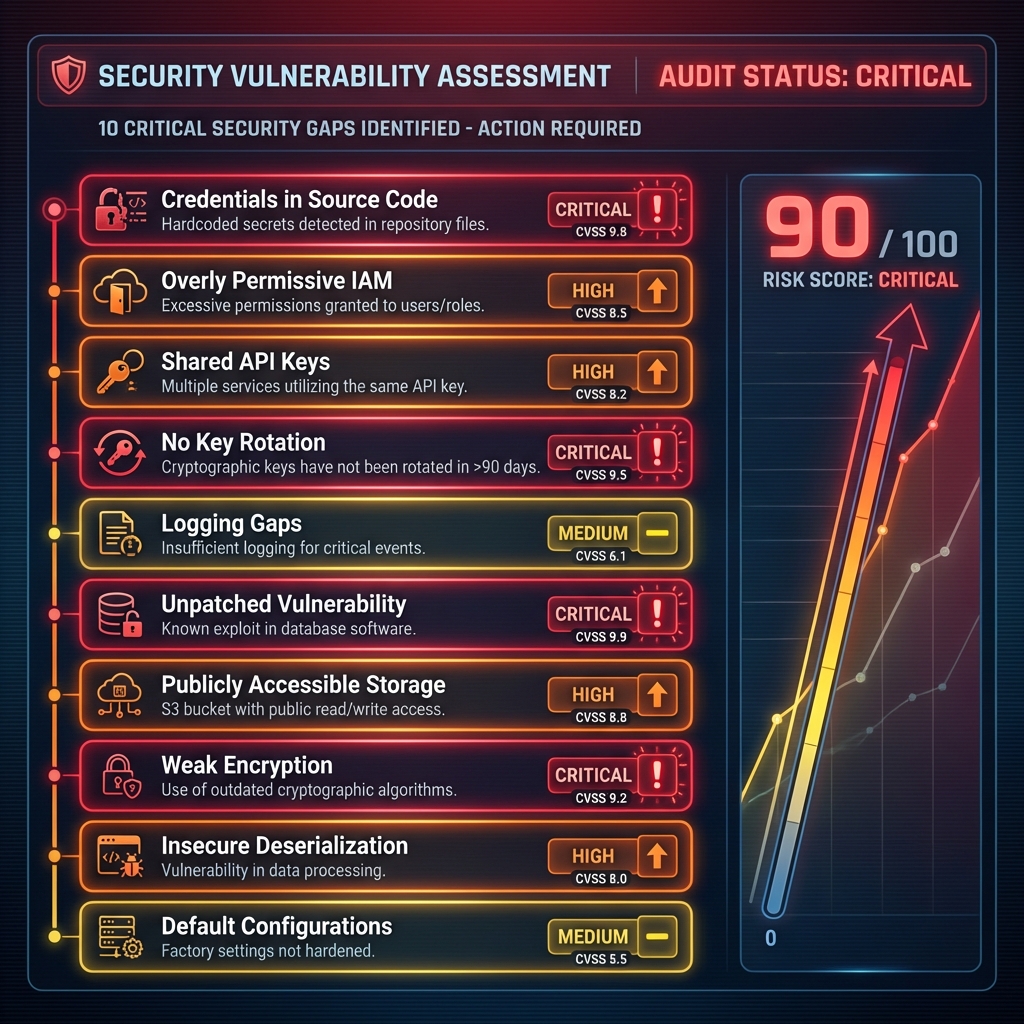
Vulnerability 1: Credentials in Source Code
Developers hardcode API keys directly in code. Attackers use automated scanners to find exposed keys on GitHub in minutes.
Vulnerability 2: Overly Permissive IAM Roles
Credentials have more permissions than needed. Attacker gets credentials with broad permissions to access all models, modify spending limits, and create new credentials.
Vulnerability 3: Shared API Keys
Same API key used for development, staging, production, multiple developers, and CI/CD pipelines. Compromise anywhere = compromise everywhere.
Vulnerability 4: No Key Rotation
API keys created once, never rotated. Keys from 2 years ago still active. Former employees still have access.
Vulnerability 5: Logging and Monitoring Gaps
Companies don't log who used which API key, when it was used, from where, or what was generated. Attack can run for weeks undetected.
Vulnerability 6: No Spending Limits
Many companies don't set hard spending caps. OpenAI allows unlimited spending if payment method valid. AWS has soft limits that can be raised automatically.
Vulnerability 7: Third-Party Tool Integration
Credentials stored in CI/CD tools, secrets managers (if misconfigured), Docker containers, Jupyter notebooks, Slack bots. Each integration point = potential leak.
Vulnerability 8: Developer Machine Compromises
Credentials stored on developer laptops in .env files, config files, terminal history, IDE settings. If developer machine is compromised, malware steals local files.
Vulnerability 9: Copy-Paste Errors
Developers paste credentials in Slack messages, emails, Stack Overflow posts, Discord forums, internal wikis.
Vulnerability 10: Cloud Misconfigurations
Public S3 buckets containing credentials, exposed CloudFormation templates, public container registries with secrets baked in.
Self-Assessment Checklist:
How many of these are true for YOUR organization?
- [ ] We have API keys older than 6 months
- [ ] Multiple people share the same API key
- [ ] We don't know all places our credentials are stored
- [ ] We have no automated alerts for unusual usage
- [ ] We don't rotate credentials regularly
- [ ] Developers commit to GitHub without scanning for secrets
- [ ] We have no spending limits on our AI services
- [ ] We don't monitor geographic origin of API calls
- [ ] Our IAM roles are overly permissive
- [ ] We've never done a credential audit
Score:
- 0-2: Good security posture (but check again)
- 3-5: Moderate risk (improvement needed)
- 6-8: High risk (likely to be compromised)
- 9-10: Extremely high risk (probably already compromised)
Related Security Guides
Strengthen your overall security posture with these complementary resources:
- AI Governance Framework for 2026 - Meet board and regulatory requirements
- Chrome Auto Browse Security - Privacy and security in the age of AI agents
- Cloud Security Best Practices - Comprehensive guide to securing cloud infrastructure
How to Protect Yourself
Let's fix this. Here's your complete protection playbook:
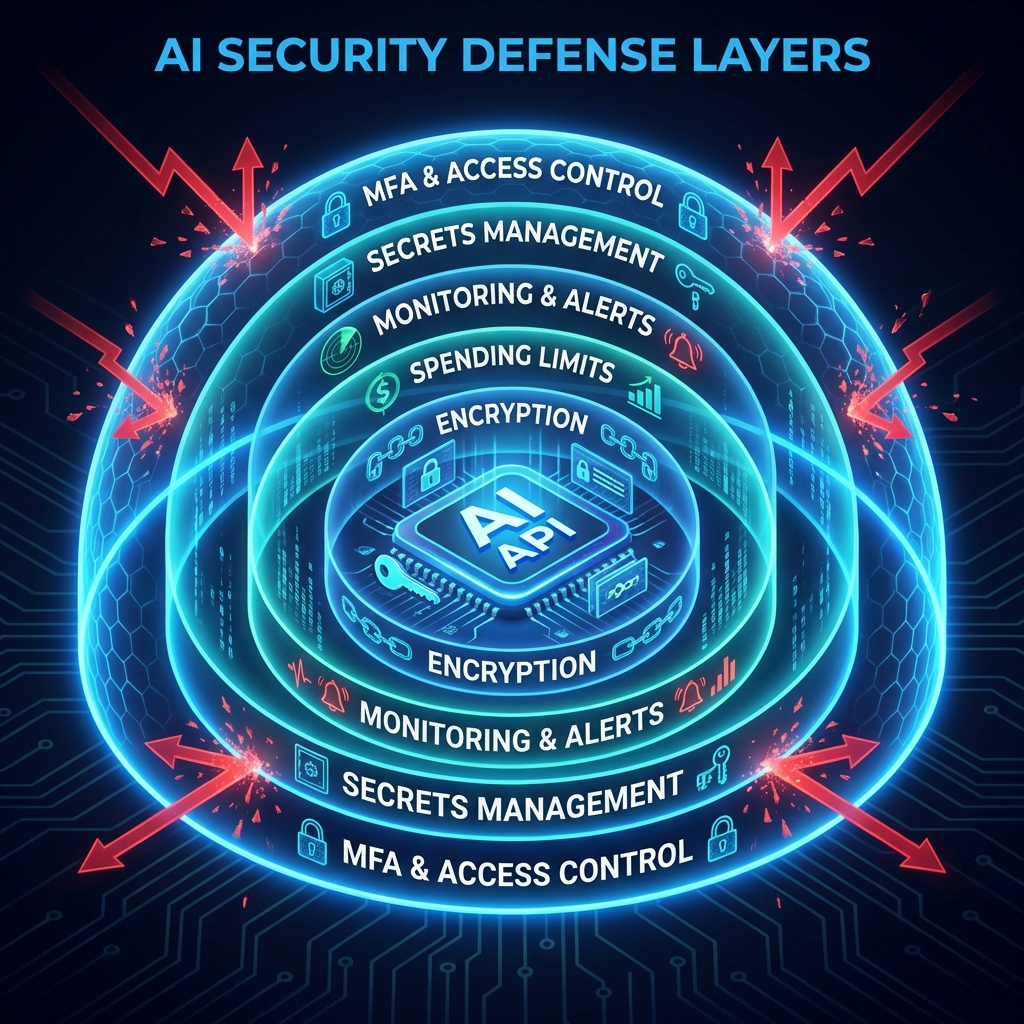
IMMEDIATE ACTIONS (Do These Today - 30 Minutes)
Action 1: Audit All API Keys
For OpenAI, Anthropic, AWS, and Google Cloud:
- List all active keys
- Delete any you don't recognize
- Delete keys older than 90 days
- Create new keys with descriptive names
Action 2: Set Hard Spending Limits
- OpenAI: Settings → Billing → Usage Limits. Set monthly hard cap.
- AWS: AWS Budgets → Create Budget. Set threshold and alerts.
- Google Cloud: Billing → Budgets & Alerts. Set budget cap.
Action 3: Enable Usage Alerts
Set up alerts for:
- Daily spending exceeds $X
- API calls from new geographic regions
- Rate limits approached or hit
- Unusual time-of-day usage patterns
SHORT-TERM ACTIONS (This Week - 2-4 Hours)
Action 4: Implement Credential Rotation
Rotate all API keys NOW. Set calendar reminder for 30 days. Build automation in parallel.
Action 5: Separate Keys by Environment
Create separate keys for:
- Development (local machines)
- Staging (testing environment)
- Production (live service)
- CI/CD (automated deployments)
- Each team member (individual dev keys)
Action 6: Implement Least Privilege Access
Instead of full access, grant specific permissions. Limit which models can be used and where they can be used from (IP restrictions).
Action 7: Scan GitHub for Exposed Secrets
Tools: TruffleHog, GitGuardian, GitHub Secret Scanning, GitLeaks. If secrets found, immediately rotate compromised credentials.
Action 8: Implement Secrets Management
Use AWS Secrets Manager, HashiCorp Vault, Azure Key Vault, Google Secret Manager, or 1Password for teams. Application retrieves secrets at runtime.
LONG-TERM ACTIONS (This Month - Ongoing)
Action 9: Implement Comprehensive Monitoring
Build dashboard tracking: API calls, token consumption, cost per day, geographic distribution, model usage, error rates.
Action 10: Deploy Anomaly Detection
Use ML to detect unusual patterns. Normal baseline vs anomaly detection.
Action 11: Enable MFA Everywhere
Multi-factor authentication for cloud console access, OpenAI account, Anthropic account, GitHub account, and any service storing credentials.
Action 12: Regular Security Audits
- Monthly: Review all active API keys, check usage patterns
- Quarterly: Full credential audit, penetration testing
- Annually: Third-party security assessment, red team exercise
Action 13: Developer Security Training
Train your team on why credential security matters, how to use secrets managers, how to avoid committing secrets to Git, and secure coding practices.
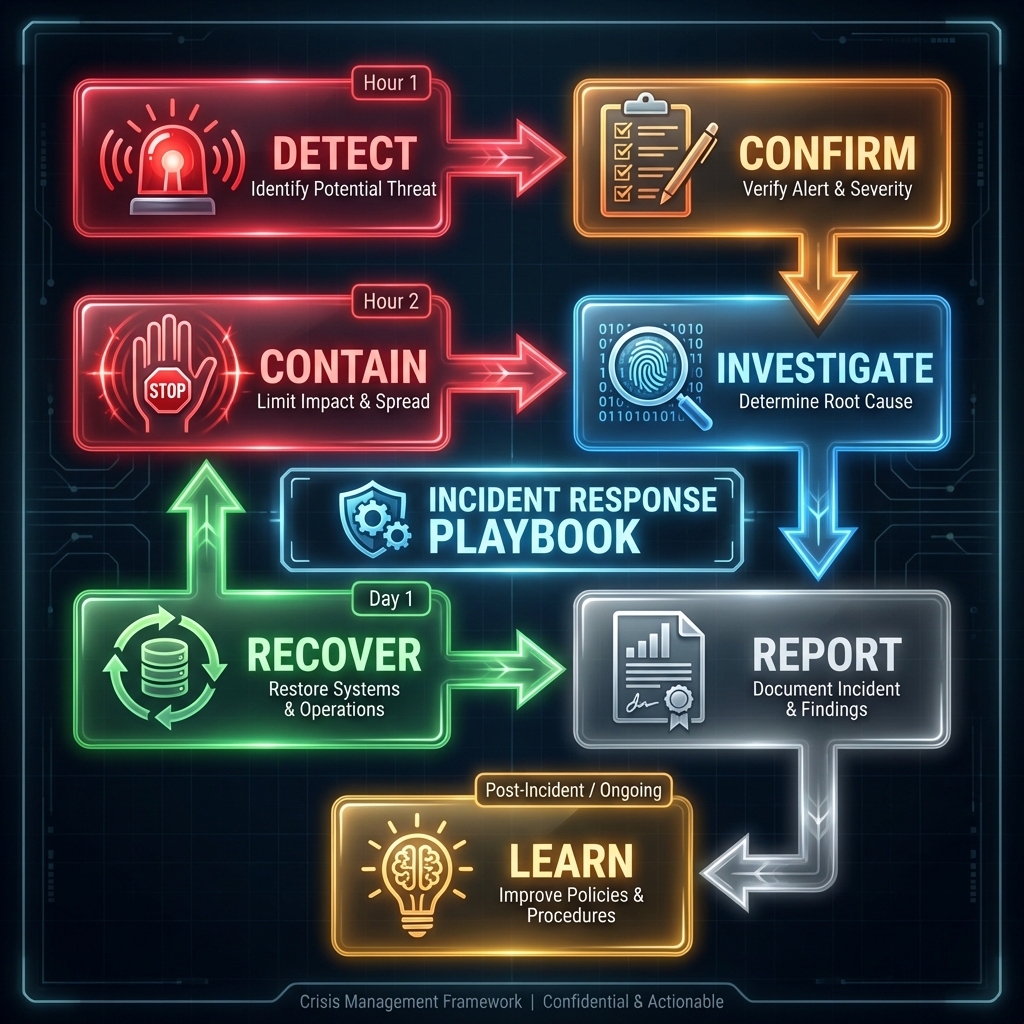
Action 14: Incident Response Plan
Create playbook for 'We've been LLMjacked':
- Detect (alerts triggered)
- Confirm (verify actual attack)
- Contain (rotate ALL credentials, revoke compromised keys)
- Investigate (how were credentials stolen?)
- Recover (deploy new credentials securely)
- Report (notify stakeholders)
- Learn (post-mortem analysis)
Security Checklist
Immediate (Today):
- [ ] Audit all API keys, delete unused/old
- [ ] Set hard spending limits on all services
- [ ] Enable usage alerts
This Week:
- [ ] Rotate all credentials (prioritize production)
- [ ] Separate keys by environment
- [ ] Implement least privilege IAM policies
- [ ] Scan GitHub for exposed secrets
- [ ] Set up basic secrets management
This Month:
- [ ] Build comprehensive monitoring dashboard
- [ ] Implement anomaly detection
- [ ] Enable MFA on all accounts
- [ ] Conduct first security audit
- [ ] Train developers on credential security
- [ ] Create incident response plan
Recommended Security Tools
These tools can help automate and strengthen your credential security:
- TruffleHog - Secret scanning for Git repositories and file systems
- GitGuardian - Real-time secret detection and remediation
- AWS Secrets Manager - Secure, scalable secrets storage for AWS
- HashiCorp Vault - Enterprise-grade secrets management across platforms
- 1Password for Teams - Developer-friendly secrets management
- GitHub Secret Scanning - Native GitHub repository protection
NovaEdge can help you evaluate, implement, and configure these tools for your specific infrastructure.Schedule a Security Consultation
If You've Already Been Attacked
You checked your bill. It's $87,000 instead of $8,000. Now what?
IMMEDIATE RESPONSE (First Hour)
Step 1: Stop the Bleeding
- Disable compromised credentials immediately
- Set spending to $0 if possible
- This stops FUTURE charges (can't undo what's already used)
Step 2: Assess the Damage
Check logs to determine:
- When did attack start?
- When did it end?
- Total tokens consumed
- Total cost incurred
- Where did calls come from?
Step 3: Identify How Credentials Were Stolen
- GitHub commits
- Phishing
- Compromised developer machine
- Third-party breach
- Insider threat
CONTAINMENT (First Day)
Step 4: Rotate ALL Credentials
Not just the compromised ones—ALL of them. Assume if one key was stolen, others might be too.
Step 5: Scan for Other Compromises
Check other cloud accounts, other AI services, related services, employee accounts. Attackers often target multiple systems simultaneously.
Step 6: Preserve Evidence
Export all logs before they age out. Screenshot dashboards. Save billing statements. Document timeline. Capture attacker IPs.
Financial Recovery
Can you get a refund?
Short answer: Probably not.
Cloud provider perspective: You were responsible for credential security. The API calls were legitimate. Resources were actually consumed.
But try anyway:
- Contact cloud provider support
- Explain situation (unauthorized access)
- Provide evidence
- Request bill adjustment or forgiveness
- Escalate if needed
Success rate: Low (<20%), but worth trying
Need Immediate Help?
If you've discovered unauthorized AI usage or suspect your credentials have been compromised, time is critical. Every hour of delay can cost thousands of dollars.
NovaEdge Emergency Response Team can help you:
- Immediately contain the breach and stop unauthorized usage
- Identify the source of the credential leak
- Implement emergency security controls
- Navigate cloud provider refund negotiations
- Conduct forensic analysis of the attack
The Broader Implications
LLMjacking isn't just about your bill. It's a symptom of larger shifts in cybersecurity.
The Paradigm Shift
Traditional Cybersecurity: Protect data (confidentiality, integrity, availability). Breaches = data stolen. Motivation: Sell data, ransom, espionage.
New Cybersecurity (Compute-Centric): Protect compute resources. Breaches = resources stolen. Motivation: Use your infrastructure for profit.
Quote from 2026 cybersecurity predictions: 'Compute power will become the new cryptocurrency. Attackers will shift from stealing data to stealing compute.'
This is happening now.
The AI Identity Crisis
Problem: We're creating millions of 'machine identities' (API keys, service accounts) faster than we can secure them.
- Average enterprise has 250,000+ machine identities
- 2-3x more than human identities
- Far less protected than human accounts
- No MFA, no rotation, no monitoring
Machine identities are the new attack surface.
Why Cloud Providers Aren't Stopping This
Uncomfortable truth: Cloud providers profit from LLMjacking.
From provider perspective:
- API calls are API calls (don't care who initiated)
- Resources were consumed (legitimately billed)
- Contract says customer responsible for credentials
- Detecting LLMjacking is hard (looks like normal usage)
- False positives would anger legitimate customers
The Incentive Problem:
Providers MAKE MONEY from LLMjacking: Victim pays inflated bill. Provider gets revenue. Attacker doesn't pay. Victim has no recourse.
Some providers are improving (AWS Cost Anomaly Detection, OpenAI usage notifications), but none have default hard spending limits, real-time anomaly blocking, or proactive fraud detection.
Don't wait for providers to protect you. Protect yourself.
Take Action in the Next 5 Minutes
Don't wait until you're the next victim. Here's what you can do RIGHT NOW:
- Check your current month's AI bill - Look for unexpected spikes
- Set up spending limit alerts - Use your provider's budget tools
- Audit your active API keys - Delete anything you don't recognize
- Enable MFA on all cloud accounts - Add an extra layer of security
Conclusion & Action Plan
LLMjacking is real, it's happening now, and it could be happening to you.
The Stakes
Financial:
- $46,000 to $100,000+ per day in unauthorized charges
- No refunds from cloud providers
- No insurance coverage (usually)
- Pure loss
Operational:
- Legitimate work blocked (hitting rate limits)
- Emergency credential rotation (service disruption)
- Team distraction (incident response)
Reputational:
- Explaining to board/investors why bills exploded
- Customer trust (if they learn you were compromised)
- Industry perception (security failure)
But You Can Prevent It
This attack is preventable with basic security hygiene:
- Proper credential management
- Spending limits
- Monitoring and alerts
- Regular audits
It's not exotic nation-state hacking. It's opportunistic criminals exploiting lazy security.
Your Action Plan (Start Right Now)
Next 5 Minutes:
- Check your current month's AI/cloud bill
- Compare to last month
- If there's a spike - investigate immediately
Next 30 Minutes:
- Audit all API keys
- Delete old/unused keys
- Set hard spending limits
This Week:
- Rotate all credentials
- Implement secrets management
- Set up monitoring and alerts
- Scan GitHub for exposed secrets
This Month:
- Build comprehensive security controls
- Train your team
- Create incident response plan
- Schedule regular audits
The Bottom Line
You have two choices:
Option 1: Ignore this, hope it doesn't happen to you - Risk: $100K+ unexpected bill - Likelihood of attack: High and growing
Option 2: Spend a few hours securing your credentials - Cost: A few hours of work - ROI: Could save $100K+
The math is obvious.
Final Thought
LLMjacking is the canary in the coal mine.
As AI becomes infrastructure, securing AI becomes critical.
This is just the beginning.
Companies that take AI security seriously NOW will survive.
Those that don't... won't.
Don't be the cautionary tale in someone else's blog post.
Secure your credentials. Monitor your usage. Protect your company.
Do it today.
About NovaEdge Digital Labs
This comprehensive security guide was created by NovaEdge Digital Labs, where we help companies navigate the intersection of AI adoption and cybersecurity.
We don't sell fear—we provide practical, actionable security solutions.
Need Help?
If you've been LLMjacked or want to audit your security posture:
- Free security assessment for companies
- Incident response consulting
- AI security implementation
Contact: contact@novaedgedigitallabs.techVisit NovaEdge Digital Labs
Built & Curated by Amit Kumar Raikwar
Full-stack engineer & product designer shipping production software worldwide.
Frequently Asked Questions
Amit Kumar Raikwar
Full-stack engineer and product designer in Indore. I take software from an empty Figma file to a live product that takes payments, and I do the interface, the API, the database and the deploy myself.