Why Custom Software Beats Off-the-Shelf SaaS When Your Business Starts Scaling
Amit Kumar Raikwar
Lead Strategist
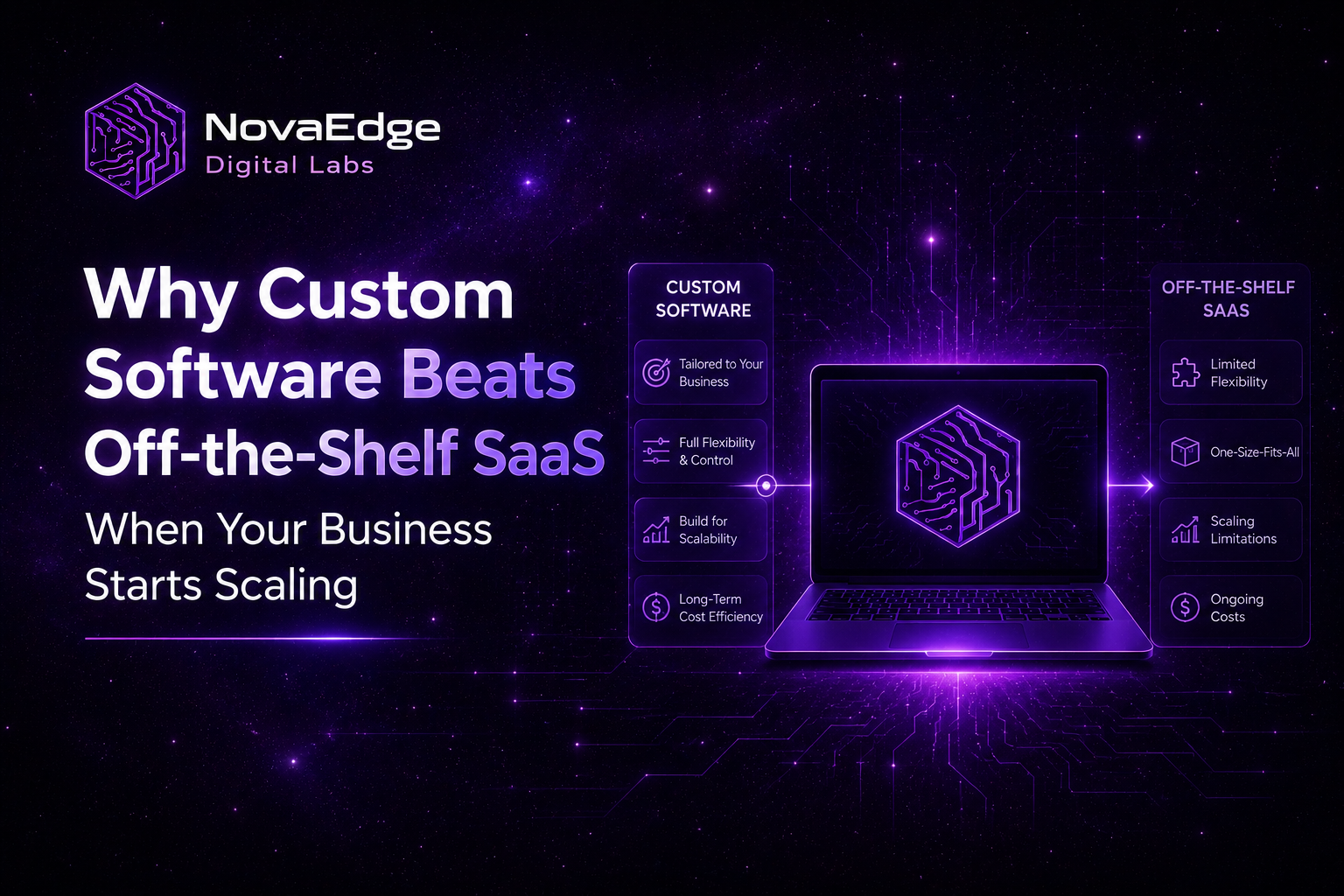
Discover why scaling businesses need to transition from off-the-shelf SaaS tools to custom software to eliminate per-seat pricing, improve integrations, and build proprietary IP.
Every successful business begins with a bit of duct tape.
When you first launch, your tech stack reflects a mindset of survival and speed. You string together Mailchimp for emails, a $29/month Shopify or WooCommerce store, Monday.com or Airtable to track orders, and QuickBooks for your bookkeeping. You don't need perfection; you need functionality. At $500k or even $1M a year in revenue, this cobbled-together software approach isn’t just acceptable—it is the smartest way to operate. It allows you to move fast without blowing your seed capital or early profits on expensive infrastructure.
But then, you hit an inflection point. You cross $5M, $10M, or $20M in revenue. Your team grows. Your processes become more sophisticated. The volume of data you process multiplies exponentially.
Suddenly, the exact same off-the-shelf SaaS tools that helped you launch are now the primary bottlenecks preventing you from growing further.
Your operations team spends hours manually copying data from one dashboard to another. You find yourself paying $12,000 a month in per-seat licenses for bloated software where your team only uses 10% of the features. Worse, you lose a massive enterprise client because your generic Customer Relationship Management (CRM) platform couldn't support the specific custom workflow or security compliance that they required.
At NovaEdge Digital Labs, we see this exact transition point all the time. Founders come to us frustrated. Their off-the-shelf software has gone from being a massive growth enabler to a suffocating growth tax.
If you are currently experiencing the growing pains of a fragmented software stack, here is a deep dive into why making the jump to custom software is usually the right strategic move for scaling businesses.
1. The Per-Seat Pricing Trap: The SaaS Tax
SaaS companies are incredibly profitable for a reason: they make money by charging you per user, per month.
When you have a lean team of five employees, paying $50 per user per month for a project management tool is negligible. It's $3,000 a year. But as you scale, this pricing model becomes fiercely punitive. When you scale your operations to 150 employees, you are suddenly paying $90,000 a year for that exact same tool.
Now multiply that across your entire organization. A scaling company typically uses a stack of five to ten different premium SaaS tools—a CRM (like Salesforce or HubSpot), an ERP (like NetSuite), a project management suite (like Asana or Jira), a customer support helpdesk (like Zendesk), and HR software. At that scale, a 150-person company can easily spend over $250,000 to $400,000 annually just on basic software licenses. You are effectively paying a massive "SaaS tax" just to keep the lights on, month after month, year after year.
Custom software requires a higher upfront build cost, but it fundamentally shifts your financial model. There are no per-seat licenses. Whether you have 50 employees, 500 employees, or 5,000 employees, your operating costs remain tied to actual server usage and maintenance—which, thanks to modern cloud architecture, is incredibly cheap. It is not tied to arbitrary user limits set by a vendor looking to maximize their MRR (Monthly Recurring Revenue).
A $100,000 or $200,000 custom software build might seem expensive initially, but it pays for itself in less than a year when you eliminate the recurring SaaS tax. More importantly, it turns an unpredictable, scaling operating expense (OpEx) into a controlled, high-value asset.
2. The Process Fit Problem: Stop Forcing Your Business into Someone Else's Box
Off-the-shelf SaaS products are built for the lowest common denominator. A SaaS product manager has a difficult job: they must design features that appeal broadly to 10,000 average companies in order to maximize their addressable market.
But here is the truth: you didn't grow your business to this scale by being average. You grew it by having a unique operational process, a specific competitive advantage, or a proprietary, superior way of delivering value to your customers.
When you use generic, off-the-shelf software, you inevitably have to alter your unique business processes to fit how the software dictates you should work. Instead of the software serving your business, your business begins serving the software.
Consider an example. We worked with a mid-sized logistics and fulfillment company that had developed a highly specific, highly efficient physical barcode scanning flow to track partial shipments arriving from multiple international vendors. It was their secret weapon for speed. However, the generic, off-the-shelf inventory SaaS they used didn't allow for their specific partial barcode scanning methodology.
Because the software couldn't accommodate their physical reality, their warehouse team had to spend 15 to 20 hours a week manually overriding the system in Microsoft Excel, double-checking partial shipments, and re-uploading CSV files. The software was dictating a slower, more error-prone reality.
We built them a custom inventory module that mapped exactly to their proprietary physical warehouse process. The UI was designed around their workers' exact scanner movements. The manual Excel work dropped to absolute zero, and their shipping error rate plummeted by 94%.
Custom software molds completely to your business. It enforces your best practices, automates your specific bottlenecks, and amplifies your unique competitive advantages. You never have to compromise your operations to satisfy a generic software's limitations again.
3. Integration Nightmares and the Fragmented Data Problem
When your business runs on a patchwork quilt of six different SaaS platforms, your company’s data is fundamentally fragmented across six different databases that you do not own or control.
To keep everything running, you rely on tools like Zapier, Make, or native API integrations to keep these systems in sync. You create complex "Zaps" that say, "When a deal closes in HubSpot, create a new row in Airtable, and send a Slack message, and generate an invoice in QuickBooks."
At a small scale, this is magic. At scale, it is a nightmare.
Integrations break silently. API limits get hit during a high-volume sales day. Webhooks drop packets. A data sync delays by just 15 minutes, causing a sales rep to call an angry customer who literally just canceled their order moments ago, making your company look incompetent.
Furthermore, gaining cross-platform insights becomes nearly impossible. If you want to run a complex, comprehensive report correlating employee shift hours (from your HR software) with specific product return rates (from your inventory software) and customer satisfaction scores (from your support software), you are out of luck. You have to export three massive CSV files, dump them into Excel, and spend your entire weekend writing complex VLOOKUPs and pivot tables. By the time you generate the report, the data is already a week old.
When you build a custom platform, you own the core database. You possess a single, unified source of truth for your customers, your inventory, your finances, and your employees. Everything talks to everything else natively, in real-time. If you want that complex report, you simply write a SQL query or build a custom dashboard widget. You get real-time, actionable business intelligence because the data isn't trapped in someone else's walled garden.
4. Building Intellectual Property and Increasing Valuation
Eventually, you may look to sell your business, take it public, or raise significant growth capital from private equity or venture capital. When institutional investors look at your business, they evaluate your assets.
If your entire operational advantage is built on top of Salesforce, Zendesk, and Shopify, you don't actually own your core technology. You are merely renting it. Your competitive moat is shallow because any well-funded competitor can simply buy the exact same software licenses tomorrow and replicate your operational infrastructure.
Building custom software fundamentally changes the nature of your business. It turns your operational processes into proprietary Intellectual Property (IP). You transition from being just a service company or a retail company into a tech-enabled business.
Buyers and investors pay significantly higher EBITDA multiples for companies that own proprietary software. Why? Because proprietary software represents a defensible moat. It proves that you are structurally more efficient, more profitable, and harder to replicate than your competitors. Your custom software becomes an asset on your balance sheet that significantly drives up the enterprise value of your company.
5. Security, Compliance, and Data Governance
As you move upmarket and start landing enterprise-level clients, you will be subjected to intense vendor security reviews.
Enterprise clients will demand to know exactly where their data is stored, who has access to it, and how it is encrypted. If you are bouncing their highly sensitive data across five different third-party SaaS tools via Zapier, passing security audits becomes incredibly difficult, if not impossible.
With custom software, you maintain total sovereignty over your data. You can host it on single-tenant, private cloud infrastructure. You can implement precise, role-based access controls (RBAC) that dictate exactly which employees can see which fields of data. You can ensure compliance with GDPR, HIPAA, SOC 2, or whatever strict regulatory framework your industry demands, without waiting for a third-party vendor to update their terms of service.
For many B2B companies, the ability to pass a Fortune 500 security audit is the single biggest ROI of a custom software build.
When Should You Actually Stick to SaaS?
With all that said, I am not telling you to build a custom email client, a custom accounting ledger, or your own internal chat app. You should absolutely still use Gmail, QuickBooks, and Slack.
The rule of thumb is this: You should only build custom software for the core operational processes that actually differentiate your business.
If a process directly touches how you deliver your specific value to your specific customers—if it is the engine of your business—you should own it. Build custom software for your proprietary quoting algorithm, your unique fulfillment process, or your specialized client portal.
If it is a generic back-office task (like running payroll, processing credit cards, or sending emails), buy it. Don't reinvent the wheel where the wheel is commoditized.
The Bottom Line
Scaling breaks things. The software architecture that helped you grind your way to your first million in revenue will rarely be the architecture that supports your path to fifty million.
As a founder or operations leader, your time is your most valuable asset. If you find your team spending more time managing your software limitations than actually managing and growing your business, the tipping point has arrived.
It is time to stop renting generic solutions that force you to compromise. It is time to start building technology that scales endlessly, unifies your data, and becomes a permanent, valuable asset for your company.
At NovaEdge Digital Labs in Indore, we specialize in helping scaling businesses transition from messy, fragmented SaaS stacks to clean, high-performance custom software solutions. If your current technology is slowing your growth, let's have a conversation about how to build a platform that actually works for you.
About Amit Kumar Raikwar
NovaEdge Digital Labs is a team of designers, developers, and strategists dedicated to pushing the boundaries of digital innovation in 2026.
Learn more about the team