What Are the Top 10 Software Companies?
NovaEdge Editorial Team
Lead Strategist
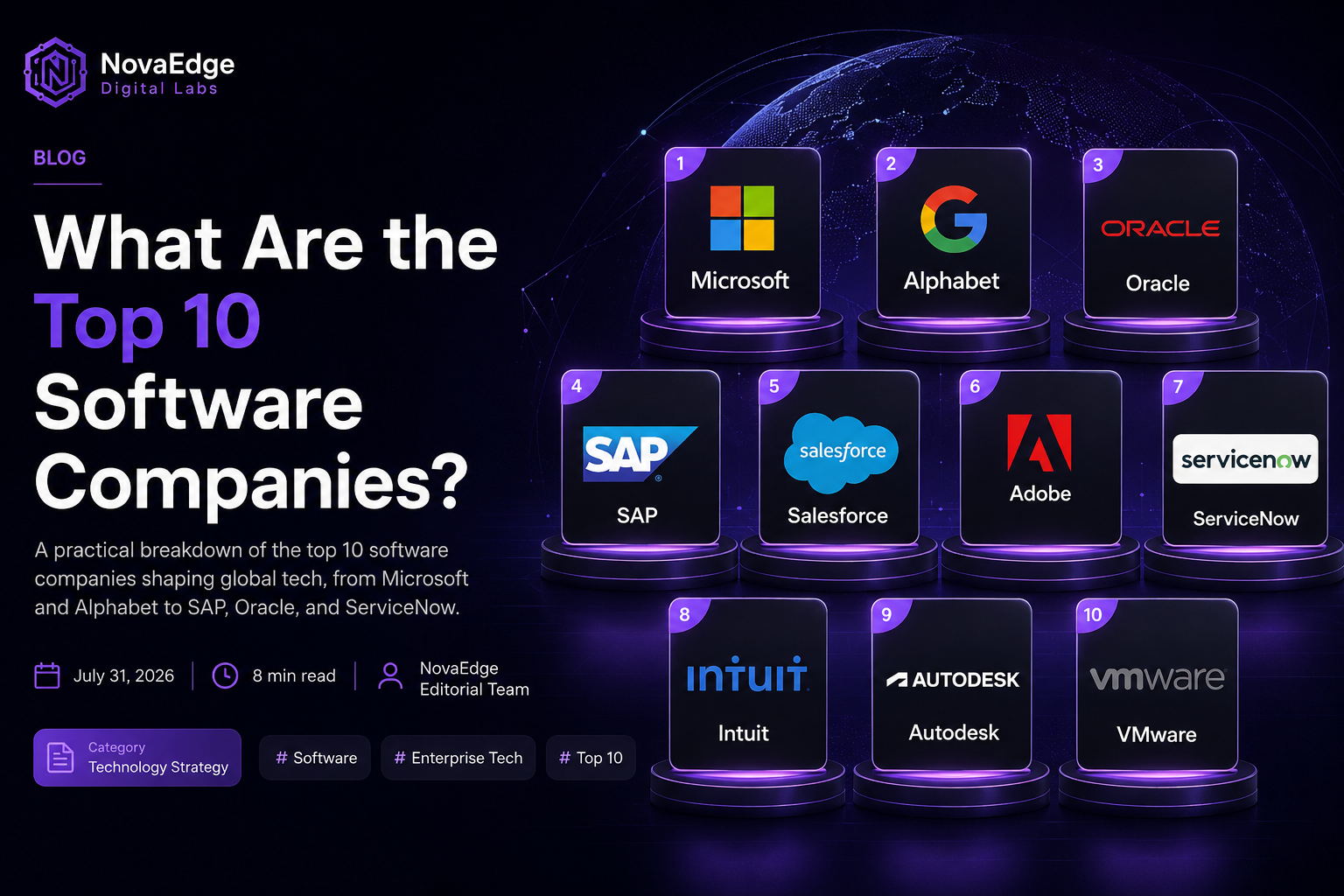
A practical, human-written guide to the top 10 software companies worldwide, exploring their core platforms, market reach, and business impact.
When people start talking about the biggest software companies in the world, the conversation usually turns to stock market valuations. But market cap only tells part of the story. The real measure of a software giant comes down to reliance: how many businesses would stall tomorrow morning if these systems suddenly went offline?
From cloud servers and operating systems to accounting ledgers and creative tools, a handful of tech firms supply the digital scaffolding for almost every industry. Here is a look at the top 10 software companies today, ranked by market impact, scale, and strategic importance.
1. Microsoft
It is almost impossible to spend a workday without interacting with Microsoft software. Windows remains the dominant desktop OS worldwide, while Microsoft 365 handles daily document creation and corporate communication for hundreds of millions of employees.
Underneath the surface, Azure has grown into a major cloud engine powering corporate databases and web apps. Add GitHub for software developers and early, aggressive investments in generative AI, and Microsoft sits firmly at the center of modern computing.
2. Alphabet (Google)
Most people think of Google as a search engine and an ad company, but its software foundation runs deep. Android operates on more than 70% of smartphones globally, giving Alphabet a direct line to mobile computing across every continent.
On the enterprise side, Google Workspace has become the standard productivity stack for younger companies and startups. Meanwhile, Google Cloud Platform (GCP) continues to win large engineering contracts specifically built around heavy data processing, container management, and machine learning models.
3. Oracle
Oracle built its fortune on relational databases decades ago, and those systems remain the operational core for thousands of banks, retail chains, and airlines. Once a company builds its financial transactions around Oracle’s database engine, replacing it becomes a high-risk, multi-year project.
Over the last decade, Oracle aggressively shifted its clients into Oracle Cloud Infrastructure (OCI) and expanded into healthcare tech with its acquisition of Cerner. Consumers rarely notice Oracle, but enterprise IT leaders deal with its software licenses constantly.
4. SAP
Based in Walldorf, Germany, SAP is Europe’s largest software vendor and the undisputed leader in Enterprise Resource Planning (ERP). If a global manufacturing company needs to order raw steel, track assembly schedules across three countries, and calculate shipping costs, SAP runs the accounting ledger behind that operation.
Its flagship platform, SAP S/4HANA, connects supply chain, human resources, and financial data into a single system. Because swapping out an ERP platform can disrupt an entire business, SAP enjoys exceptionally long customer relationships.
5. IBM
IBM has reinvented itself repeatedly over its long history. Having moved away from consumer hardware, the company now focuses heavily on hybrid cloud software, enterprise security, and systems integration.
The major catalyst was its $34 billion purchase of Red Hat, which brought Red Hat Enterprise Linux and OpenShift into the IBM fold. This software gives big institutions—especially banks and government bodies—a flexible way to manage code across private data centers and public cloud hosts.
6. Intuit
Intuit focuses on a very specific, high-demand area: financial logistics. QuickBooks acts as the default accounting software for millions of small business owners, handling invoicing, expenses, and employee payroll.
On the consumer side, TurboTax dominates self-filed tax returns in North America. By adding Credit Karma for personal finance and Mailchimp for email marketing, Intuit has created a sticky software ecosystem that small businesses rarely abandon.
7. Adobe
Adobe essentially owns the digital creative workflow. Photoshop, Illustrator, Premiere Pro, and InDesign are industry standards for graphic designers, filmmakers, and publishers. If you see a billboard or watch a polished online video, odds are an Adobe app was involved.
Adobe also created the PDF standard and turned Acrobat into a recurring subscription revenue driver. Transitioning from physical disc sales to the Creative Cloud subscription model years ago turned Adobe into one of the most consistently profitable software companies around.
8. Salesforce
Salesforce pioneered the web-delivered business software model back when most companies were still installing programs from CDs. Its Customer Relationship Management (CRM) platform gives sales teams a single place to track leads, customer histories, and revenue pipelines.
Over time, Salesforce expanded its footprint by purchasing Tableau for data charts, MuleSoft for connecting APIs, and Slack for workplace messaging. It has become the primary operational hub for customer-facing teams.
9. ServiceNow
ServiceNow might not be a household name, but it has quietly established a grip on corporate operations. Its software manages internal ticketing and workflow automation. When a new employee gets hired, needs an IT laptop upgrade, or requests time off, ServiceNow routes those tasks behind the scenes.
By organizing chaotic internal emails into structured digital workflows, ServiceNow helps large companies reduce operational drag, driving rapid enterprise growth.
10. Shopify
Shopify offers a different flavor of software: commerce infrastructure. Instead of forcing sellers into a closed marketplace, Shopify gives merchants the tools to build, launch, and scale their own online stores.
It handles everything from inventory tracking and storefront design to payment processing via Shop Pay. Millions of independent brands and established retailers use Shopify as their digital storefront, making it a cornerstone of modern e-commerce.
What Keeps These Software Giants on Top?
Looking closely at this group reveals a clear pattern. The most valuable software companies do not just build clever applications; they build systems that become hard to live without.
High switching costs, recurring subscription models, and deep integrations make these products durable. Once a company trains its staff on Salesforce, stores its files in Google Workspace, or runs its logistics on SAP, replacing that software is painful. That lock-in is precisely why these 10 companies continue to lead the industry.
Frequently Asked Questions
About NovaEdge Editorial Team
NovaEdge Digital Labs is a team of designers, developers, and strategists dedicated to pushing the boundaries of digital innovation in 2026.
Learn more about the team