Flutter vs React Native: Which is Better for Your App?
Amit Kumar Raikwar
Lead Strategist
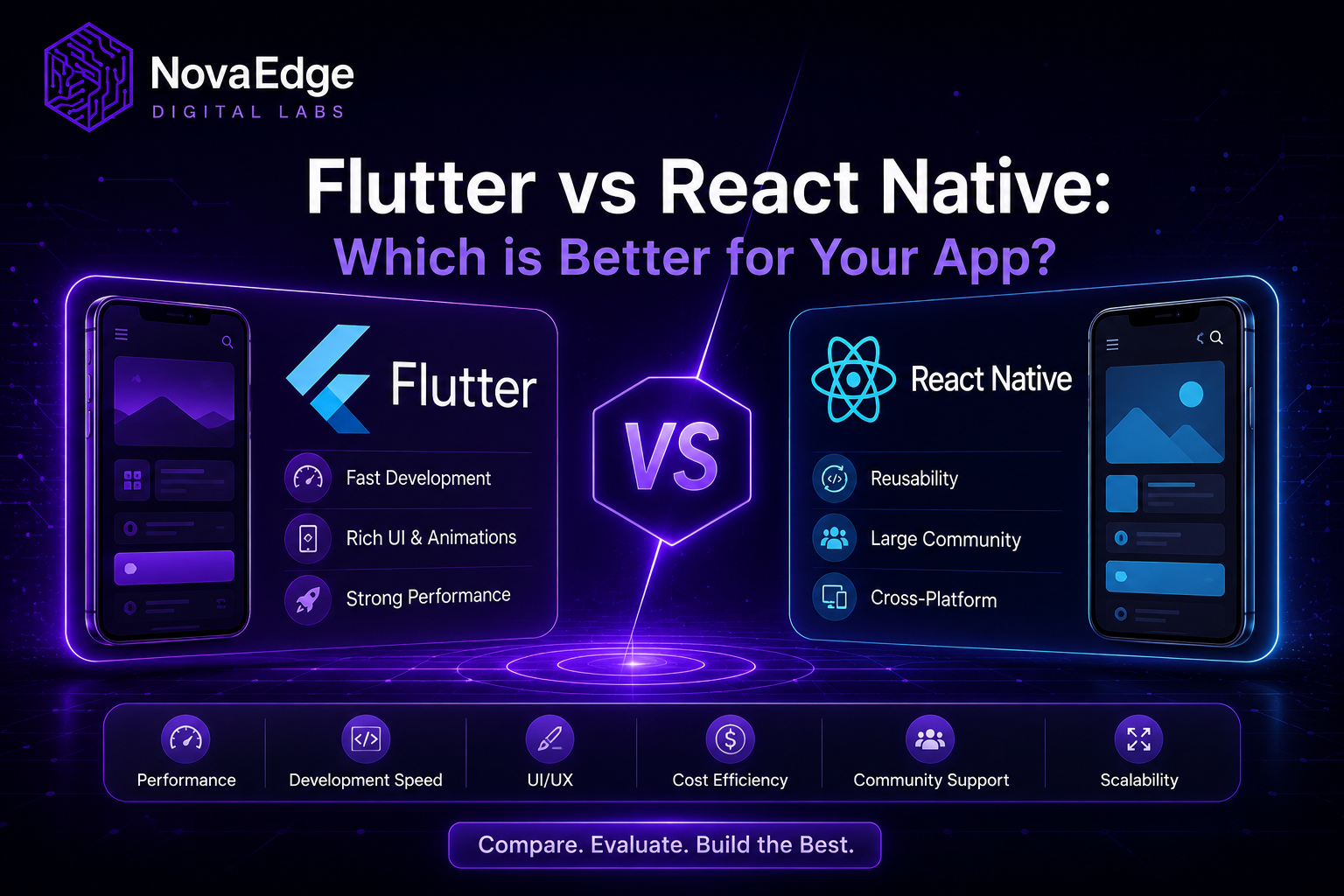
An honest, side-by-side look at Flutter and React Native — what each does well, where each falls short, and how to pick the right framework for your next mobile app.
If you are planning to build a mobile app that works on both Android and iOS, you have almost certainly run into this question: should we use Flutter or React Native?
It is one of the most debated topics in mobile development, and for good reason. Both frameworks let you build apps for multiple platforms from a single codebase. Both are backed by tech giants — Flutter by Google, React Native by Meta. Both have massive communities, solid documentation, and production-grade apps running in the wild.
But they are not the same tool. They take fundamentally different approaches to solving the same problem, and those differences matter when you are deciding where to invest your time and money.
This post gives you an honest comparison — no cheerleading for either side, no recycled talking points. Just a straightforward breakdown of how these two frameworks actually differ and which one makes more sense for your specific situation.
The Core Difference: How They Actually Work
Before comparing features, it helps to understand the architectural difference between the two. This is where their paths split, and it affects almost everything else downstream.
React Native uses JavaScript. Your app's logic runs in a JavaScript engine, and when it needs to display something on screen, it communicates with the platform's native UI components — the same buttons, text fields, and scroll views that a fully native Android or iOS app would use. The result looks and feels native because it literally is native UI.
Flutter takes a completely different approach. It uses Dart as its programming language and comes with its own rendering engine. Instead of using the platform's native UI components, Flutter draws every single pixel on screen itself using Skia (and now Impeller, its newer engine). Your app does not rely on Android or iOS to render buttons or text — Flutter paints everything from scratch on a canvas.
Think of it this way: React Native is like a translator who takes your instructions and passes them to the local workers (native components) who build the house. Flutter is like bringing your own construction crew who builds the entire house themselves, regardless of the local building conventions.
This single architectural difference drives most of the trade-offs between the two frameworks.
Performance: Close Enough for Most, Different Where It Counts
The performance debate is the one that generates the most heat and the least clarity. So let us be specific.
For a typical business app — a dashboard, a list of items, a form, a profile screen, a checkout flow — both Flutter and React Native perform well. Your users will not notice a meaningful difference. If anyone tells you that one framework is dramatically faster than the other for standard CRUD applications, they are oversimplifying.
Where the difference shows up is in heavy UI work. Complex animations, custom transitions, screens with dozens of independently animating elements, or apps that demand consistent 60fps scrolling through large data sets — Flutter has a structural advantage here because it controls the entire rendering pipeline. There is no bridge, no translation layer, no waiting for native components to respond. Flutter's Impeller engine compiles shaders ahead of time, which eliminates the jank that older versions used to struggle with on first run.
React Native's new architecture — Fabric for rendering and TurboModules for native module access — has significantly improved things. The old bridge that used to bottleneck communication between JavaScript and native code is being replaced with a faster, synchronous interface. This is a real improvement, and it has made React Native competitive in scenarios where it previously struggled.
The honest answer: Flutter has a slight edge in raw rendering performance. React Native has closed the gap and is perfectly fast for the vast majority of apps people actually build.
Developer Experience: Two Very Different Workflows
This is where personal preference and team composition start to dominate the decision.
React Native uses JavaScript (or TypeScript, which most teams adopt). If your development team has web experience — and most do, because JavaScript is the most widely used programming language on the planet — the learning curve is gentle. React Native's component model is essentially React, so anyone who has built a React web app can start building mobile screens almost immediately. The mental model transfers directly.
Flutter uses Dart, a language Google created that is not widely used outside the Flutter ecosystem. This is both a strength and a weakness. Dart is a clean, modern language with strong typing, ahead-of-time compilation, and excellent tooling. Developers who learn it generally like it. But it is an additional language your team needs to pick up, and it limits the pool of developers you can hire compared to JavaScript.
Flutter's widget system is opinionated in a way that React Native is not. Everything in Flutter is a widget — the layout, the styling, the structure, even the padding. This creates deeply nested code that can look intimidating at first. But once your team gets used to it, the consistency is actually a productivity advantage. There is one way to build things, and that predictability makes large codebases easier to maintain.
React Native gives you more flexibility in how you structure your app, which is a double-edged sword. More freedom means more decisions, and more decisions mean more opportunities for inconsistency across a team. State management alone has half a dozen popular options in the React Native world — Redux, Zustand, MobX, Jotai, Context API, and more. Flutter's ecosystem is narrower but more standardized, with Riverpod and Bloc covering most use cases.
Both frameworks offer hot reload, which lets you see code changes instantly without restarting the app. Flutter's hot reload is widely considered slightly faster and more reliable, but React Native's has improved substantially.
UI Consistency vs. Native Feel
This is a trade-off that does not get enough honest discussion.
Because Flutter draws everything itself, your app will look identical on Android and iOS. Every pixel, every animation, every shadow and rounded corner will be exactly the same on both platforms. If your brand demands pixel-perfect visual consistency across devices, Flutter delivers that without extra effort.
The downside is that Flutter apps do not automatically adopt platform conventions. An iOS user expects a certain style of navigation, a specific kind of date picker, a particular scroll behavior. A Flutter app can mimic these, but it requires deliberate work. Out of the box, a Flutter app feels like a Flutter app — not quite Android, not quite iOS. Some users notice this. Many do not.
React Native, by contrast, uses actual native components. A button on iOS looks and behaves like an iOS button. A list on Android scrolls like an Android list. Your app inherits the platform's look and feel naturally. Users feel at home because the interface elements are the same ones they interact with in every other app on their phone.
The trade-off is that achieving visual consistency across platforms in React Native requires more work. You might need to write platform-specific styles or use conditional rendering to handle differences between Android and iOS.
The question to ask yourself is: do you want your app to look the same everywhere, or do you want it to feel native on each platform? There is no wrong answer — it depends on your brand and your users.
Ecosystem and Third-Party Libraries
React Native has been around since 2015. Flutter launched its stable version in 2018. That three-year head start gave React Native a larger ecosystem of third-party packages, community solutions, and battle-tested libraries.
More importantly, React Native sits inside the JavaScript ecosystem — the largest software ecosystem in existence. Need a date library? A form validation tool? A state machine? A GraphQL client? Chances are there is a mature, well-maintained JavaScript package that works out of the box or with minimal adaptation.
Flutter's package ecosystem on pub.dev has grown rapidly and covers most common needs — navigation, HTTP requests, local storage, maps, camera access, push notifications. But for niche requirements, you are more likely to hit gaps. You might need to write a platform channel to access native functionality that no existing Dart package covers.
That said, Flutter's first-party support is exceptionally strong. Google provides official, well-maintained packages for Firebase, Google Maps, Google Ads, and dozens of other services. If your app lives within the Google ecosystem, the integration experience is seamless.
Hiring and Team Building: The Practical Reality
This might be the most underrated factor in the decision, and it deserves an honest conversation.
JavaScript developers are everywhere. Finding React Native developers — or web developers who can transition to React Native quickly — is significantly easier than finding Flutter developers. The talent pool is larger, the resumes are more abundant, and the salary expectations are generally comparable.
Flutter developers are growing in number, especially in India where the Flutter community has exploded over the past three years. But the pool is still smaller. Hiring a senior Flutter developer who understands Dart deeply, knows how to write efficient widget trees, and has shipped production apps takes more effort.
There is a flip side to this. Because Flutter requires learning Dart — a language with fewer job opportunities outside Flutter — Flutter developers tend to be more specialized and more committed to the ecosystem. They are less likely to be casual dabblers. When you find a good Flutter developer, they usually know the framework thoroughly.
If you are building a team from scratch, consider which skill set is easier to recruit and retain in your city and budget. In Indian cities like Bengaluru, Pune, and Indore, both skill sets are available, but JavaScript and React expertise remains more common. For a deeper look at how location affects your development costs, we broke down the numbers in our post on how much it costs to build a mobile app in India.
When Flutter is the Right Choice
Pick Flutter when your project fits these conditions:
- You need pixel-perfect UI consistency across Android and iOS — a single visual identity with no platform-specific variations.
- Your app is UI-heavy with complex animations, custom transitions, or visually rich interfaces that need to run at a solid 60fps.
- You are building for multiple surfaces — mobile, web, and desktop — from one codebase and want Google's official multi-platform support.
- Your team is starting fresh with no strong existing preference for JavaScript or Dart, and you value the framework's opinionated, all-in-one approach.
- You are building a consumer-facing app where visual polish and smooth interactions are a primary differentiator.
When React Native is the Right Choice
Pick React Native when your project fits these conditions:
- Your team already knows JavaScript, TypeScript, or React — the transition cost to React Native is minimal.
- You want your app to feel native on each platform, using the actual UI components that Android and iOS users are accustomed to.
- Your app needs deep integration with the JavaScript ecosystem — specific npm packages, shared business logic with a web app, or a Node.js backend.
- You are working with an existing React web codebase and want to share components, types, and business logic between web and mobile.
- Hiring and scaling your development team quickly is a priority, and you need access to a larger talent pool.
What About Long-Term Maintenance?
Both frameworks are actively maintained by their parent companies with no signs of slowing down.
Flutter has the advantage of controlling the entire rendering stack. When Google updates Flutter, your app's behavior is less likely to break because of an OS update — Flutter does not depend on native components that Apple or Google might change.
React Native's reliance on native components means that major OS updates can occasionally break things. A new version of iOS might change how a native component behaves, and your React Native app inherits that change whether you want it or not. This is manageable, but it means you need to budget time for testing and updates after every major OS release.
Both frameworks have upgrade paths that can be painful. React Native's major version upgrades have historically been a source of developer frustration, though the process has improved. Flutter upgrades are generally smoother, though Dart language changes can occasionally require non-trivial refactoring.
The Bottom Line
There is no universal winner between Flutter and React Native. Anyone who tells you one is categorically better than the other is either selling you something or has not used both in production.
Flutter is a stronger pick when visual consistency, rendering performance, and multi-platform reach are your top priorities. React Native is a stronger pick when team familiarity with JavaScript, access to the npm ecosystem, and a truly native feel on each platform matter most.
The framework matters less than most people think. What matters far more is the quality of your development team, the clarity of your requirements, and the discipline of your engineering process. A great team will build a great app in either framework. A weak team will struggle regardless of which tool they use.
Choose based on your team, your project, and your constraints — not based on which framework won the latest popularity contest on social media.
At NovaEdge Digital Labs, we have shipped production apps in both Flutter and React Native. We do not push one framework over the other — we recommend the one that fits your business, your timeline, and your team. If you are weighing this decision right now and want a technical opinion grounded in your specific situation, reach out. We will give you a straight answer.
Frequently Asked Questions
About Amit Kumar Raikwar
NovaEdge Digital Labs is a team of designers, developers, and strategists dedicated to pushing the boundaries of digital innovation in 2026.
Learn more about the team