Local SEO Guide for Small Businesses in India (Step-by-Step)
Amit Kumar Raikwar
Lead Strategist
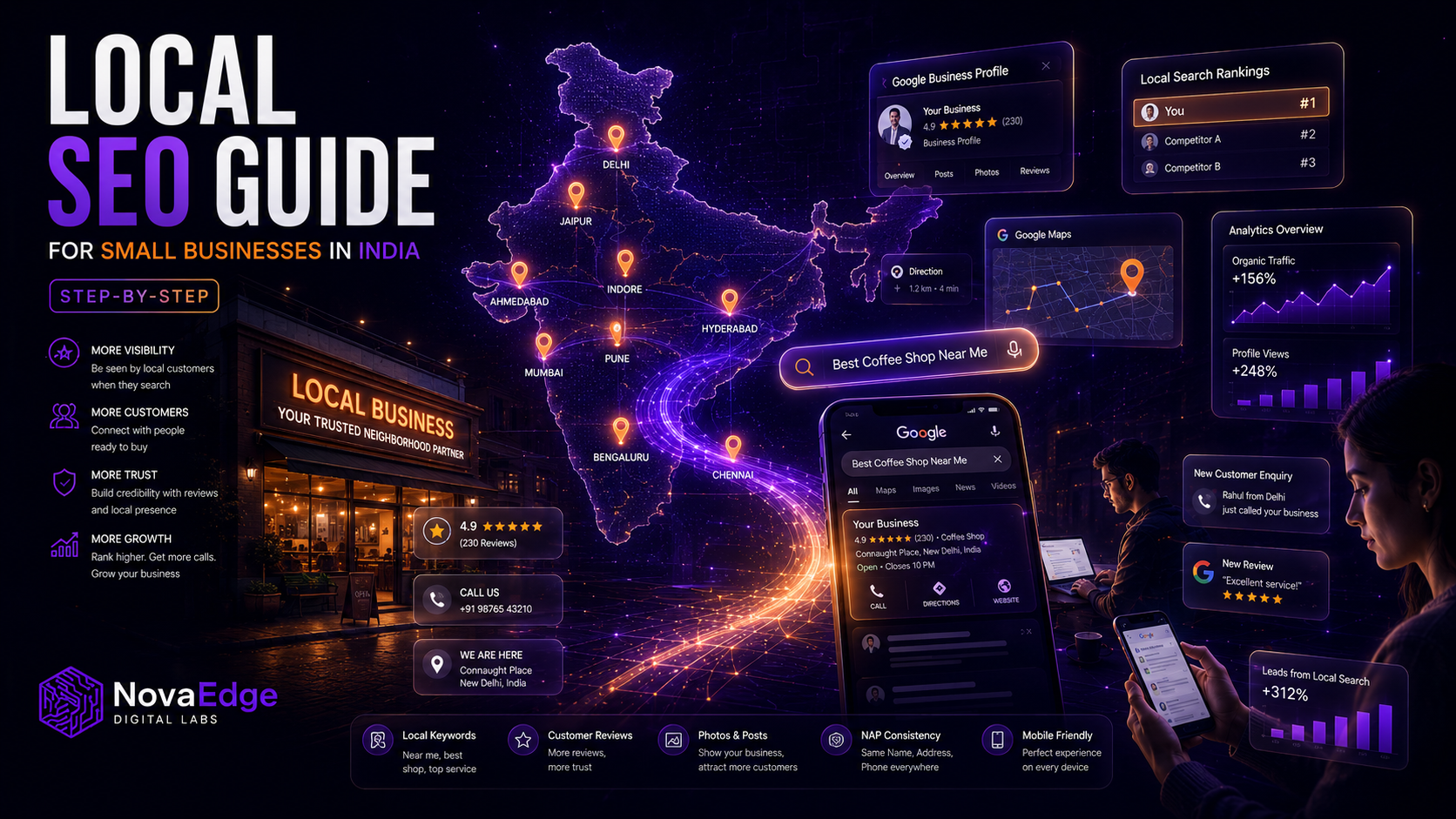
A practical, no-nonsense local SEO guide written for Indian small business owners who want their shop, clinic, or service to show up when nearby customers search on Google.
A customer is standing two kilometres from your shop. They pull out their phone, type 'best AC repair near me,' and Google shows them three businesses. Yours is not one of them. They call your competitor, get the job done, and never even know you exist.
This happens thousands of times every day across India. Small businesses with perfectly good services lose customers — not because of price, not because of quality, but because they are invisible in local search results.
Local SEO fixes that. It is the specific set of actions that make your business show up when people in your area search for what you offer. And unlike paid ads that stop working the moment you stop paying, local SEO builds a lasting presence that keeps bringing customers to your door.
This guide walks you through the entire process, step by step, with everything tailored for small businesses operating in Indian cities and towns. If you are new to the concept of SEO itself, our earlier post on what SEO is and why your business needs it covers the fundamentals.
Step 1: Claim and Optimize Your Google Business Profile
This is the single most important step in local SEO. If you do nothing else on this list, do this one.
Google Business Profile (formerly Google My Business) is the free listing that appears when someone searches for your business by name, or when Google shows the map pack — that block of three businesses with a map that appears at the top of local search results. If you have ever searched for 'dentist near me' or 'restaurant in Bhopal' and seen businesses listed with their address, phone number, ratings, and photos, that is Google Business Profile at work.
Here is how to set yours up properly.
- Go to business.google.com and either claim your existing listing or create a new one. Google may have already created a basic listing for your business based on publicly available information.
- Fill in every single field. Business name (use your real, registered name — do not stuff keywords into it), address, phone number, website URL, business hours, and category. Choose the most specific category that matches your business. If you run a dental clinic, select 'Dental Clinic' rather than just 'Health.'
- Write a detailed business description. You have 750 characters. Use them to explain what you do, who you serve, and what sets you apart. Mention your city and the areas you cover naturally — not in a forced, repetitive way.
- Upload high-quality photos. At least 10 to start with — your storefront, the interior, your team, your products, and any relevant work samples. Businesses with photos get 42 percent more requests for directions and 35 percent more clicks to their website than those without.
- Set your service area if you travel to customers instead of operating from a fixed location. Google lets you define the cities or districts you cover.
Step 2: Get Your NAP Consistent Everywhere
NAP stands for Name, Address, and Phone number. It sounds trivial, but inconsistency in these three details across the internet is one of the most common reasons small businesses struggle with local search rankings.
If your Google Business Profile says your address is '14, MG Road, Indore' but your website says '14 MG Road, Indore, MP' and Justdial lists you as '14, Mahatma Gandhi Road, Indore,' Google treats these as potentially different businesses. That confusion weakens your ranking.
Pick one exact format for your business name, address, and phone number. Use that identical format on your website, your Google Business Profile, your social media pages, every directory you are listed on, and every citation across the internet. Consistency tells Google that all these references point to the same, real, trustworthy business.
Step 3: Build Local Citations on Indian Directories
Citations are mentions of your business on other websites — directories, listing platforms, and industry-specific portals. Each citation reinforces your existence and legitimacy in Google's eyes.
For Indian businesses, the most important directories to list on include Justdial, Sulekha, IndiaMART (for B2B businesses), Practo (for healthcare), Zomato (for restaurants), UrbanClap/Urban Company (for service providers), Yellow Pages India, and TradeIndia. Beyond these, look for directories specific to your industry or city.
When creating these listings, use the exact same NAP format you established in Step 2. Add your website URL, business hours, and a description wherever the platform allows. The more consistent, complete listings you have across reputable directories, the stronger your local SEO foundation becomes.
Step 4: Target Local Keywords on Your Website
Local keywords are search phrases that include a location. 'Chartered accountant in Pune,' 'wedding photographer Jaipur,' 'laptop repair shop Nehru Place Delhi' — these are the searches your potential customers are actually typing into Google.
Your website needs to include these terms naturally in the right places. Here is where they matter most.
- Page titles and meta descriptions. Your homepage title should include your primary service and city. Something like 'Reliable Plumbing Services in Lucknow | [Your Business Name]' is clear and specific.
- Headings on your pages. Use H1 and H2 tags that mention your service and location where it reads naturally.
- Your website content. Write paragraphs that describe your services in the context of your location. Do not force it — write sentences that a human would naturally say. 'We have been providing pest control services across Nagpur and surrounding areas for over eight years' is natural. 'Best pest control Nagpur pest control services Nagpur' is keyword stuffing and will hurt you.
- Image alt text. Describe your images using relevant, local terms. A photo of your shop front could have alt text like 'Front view of Sharma Electronics repair shop in Laxmi Nagar, Delhi.'
- Create separate pages for each service and location if you serve multiple areas. A single page trying to rank for 'CA services in Pune, Mumbai, Nashik, and Aurangabad' will struggle. Individual pages for each city perform far better.
Step 5: Earn Reviews — and Respond to Every Single One
Reviews are one of the strongest ranking signals for local SEO. A business with 40 genuine reviews and a 4.5-star rating will almost always outrank a business with 3 reviews, even if the second business has a better website.
But getting reviews requires a system. Most happy customers will not leave a review unless you make it effortless for them. Here is what works.
Ask at the right moment. After you have delivered a service and the customer is satisfied, send them a direct link to your Google review page. You can generate this link from your Google Business Profile dashboard. Send it via WhatsApp — in India, this is by far the most effective channel for review requests. A simple message like 'Thank you for choosing us. If you have a moment, your feedback here would mean a lot to us' with the link attached works consistently.
Respond to every review. Thank people for positive reviews with a specific, personal reply — not a copy-pasted template. For negative reviews, respond professionally, acknowledge the issue, and offer to resolve it. Google watches how businesses interact with reviewers. Active, thoughtful responses signal that your business is engaged and cares about its customers.
Never buy fake reviews. Google's detection systems are increasingly effective at identifying fraudulent reviews, and getting caught can result in your listing being suspended entirely. Build your review count honestly, even if it takes longer.
Step 6: Make Your Website Fast and Mobile-Friendly
In India, the overwhelming majority of local searches happen on mobile phones. A customer standing outside your competitor's shop, checking if there is a better option nearby, is doing that on their phone — not on a laptop.
If your website takes more than three seconds to load on a mobile connection, you will lose that customer before they even see your homepage. Google also uses page speed and mobile usability as direct ranking factors.
Test your website using Google PageSpeed Insights. It will show you exactly what is slowing your site down and how to fix it. The most common culprits for Indian business websites are uncompressed images, cheap shared hosting with slow servers, and outdated website builders that load unnecessary code.
Make sure your phone number is clickable — a visitor should be able to tap it and call you directly without copying and pasting. Make sure your address links to Google Maps. These small details convert mobile visitors into actual customers.
Step 7: Create Content That Serves Your Local Audience
Content is not just blog posts for the sake of filling up your website. For local SEO, the most effective content directly answers questions that people in your area are asking.
If you run a pest control company in Chennai, write a detailed post about 'How to Deal with Termites During Chennai's Monsoon Season.' If you are a CA firm in Ahmedabad, write about 'GST Filing Deadlines That Ahmedabad Business Owners Miss Every Year.' These pieces of content target real searches, establish your expertise, and naturally include local keywords without any awkward stuffing.
You can also create location-specific landing pages if your business serves multiple areas. A home cleaning service in Hyderabad might have separate pages for Gachibowli, Madhapur, Banjara Hills, and Secunderabad — each with content specific to that neighbourhood, mentioning landmarks, common housing types, and the specific services most in demand there.
Step 8: Build Local Backlinks
Backlinks — links from other websites to yours — remain one of the strongest signals Google uses to determine how trustworthy and authoritative your website is. For local SEO, links from other local businesses and organizations carry particular weight.
Here are practical ways Indian small businesses can earn local backlinks.
- Partner with complementary local businesses. A wedding photographer can exchange website links with a wedding planner, a florist, and a catering company. These are natural, relevant connections that Google values.
- Sponsor local events, college fests, or community activities. Most event websites link back to their sponsors.
- Join your local Chamber of Commerce or trade association. Their member directories almost always include a link to your website.
- Contribute a guest article to a local news website or industry blog. Dainik Bhaskar, local editions of The Times of India, city-specific business blogs — these outlets are often open to well-written, useful content from local business owners.
- Get listed on your city's municipal or tourism website if applicable. Restaurants, hotels, and tourist services can often earn links from official city portals.
Step 9: Use Google Business Profile Posts Regularly
Most small businesses set up their Google Business Profile and then never touch it again. That is a missed opportunity. Google lets you publish posts directly on your profile — updates, offers, events, and product highlights. These posts appear in your knowledge panel when someone searches for your business.
Post at least once a week. Share a seasonal offer, announce new services, post a photo of a recent project, or share a customer success story. Regular posting signals to Google that your business is active and engaged, which can positively influence your ranking in local results.
Step 10: Track What is Working
Local SEO is not a set-and-forget exercise. You need to track your progress and adjust based on what the data tells you.
Google Business Profile has built-in insights that show you how many people viewed your profile, how they found you (direct search vs. discovery), how many clicked to call, requested directions, or visited your website. Review these numbers monthly.
Install Google Search Console on your website — it is free — and monitor which search queries are bringing visitors to your site. If you notice that you are ranking on page two for a valuable local keyword, that is a signal to create more content around that topic or strengthen the page that is already ranking.
Pay attention to which competitors consistently appear above you in local results. Study their Google Business Profile — how many reviews they have, how often they post, what categories they use, and what their website covers that yours does not. Local SEO is a relative game. You do not need to be perfect. You need to be better than the other businesses competing for the same customers in your area.
The Businesses That Show Up Are the Businesses That Grow
Local SEO is not complicated. It is not reserved for big companies with big budgets. It is a series of deliberate, practical steps that any small business owner in India can start taking today. The tools are mostly free. The knowledge is in this guide. The only thing standing between your business and a steady stream of local customers finding you through Google is whether you actually do the work.
Every day you wait is a day your competitors collect the customers who should have found you instead. A kirana store in Varanasi, a salon in Coimbatore, a tuition centre in Patna, a fabrication shop in Rajkot — every one of these businesses can own its local search results with consistent, focused effort.
Start with Step 1. Claim your Google Business Profile. Fill it out completely. Then work through the rest of this guide one step at a time. Within a few months, you will see your business appearing where it matters most — right in front of the people who are already looking for exactly what you offer.
At NovaEdge Digital Labs, we have helped small businesses across India set up their local SEO from scratch and start appearing in search results that actually bring in customers. If you would rather have professionals handle this while you focus on running your business, reach out to us. We will audit your current local presence, tell you exactly where the gaps are, and build a plan that gets results — no jargon, no empty promises.
Frequently Asked Questions
About Amit Kumar Raikwar
NovaEdge Digital Labs is a team of designers, developers, and strategists dedicated to pushing the boundaries of digital innovation in 2026.
Learn more about the team