How Much Does It Cost to Develop a Mobile Game in India?
NovaEdge Editorial Team
Lead Strategist
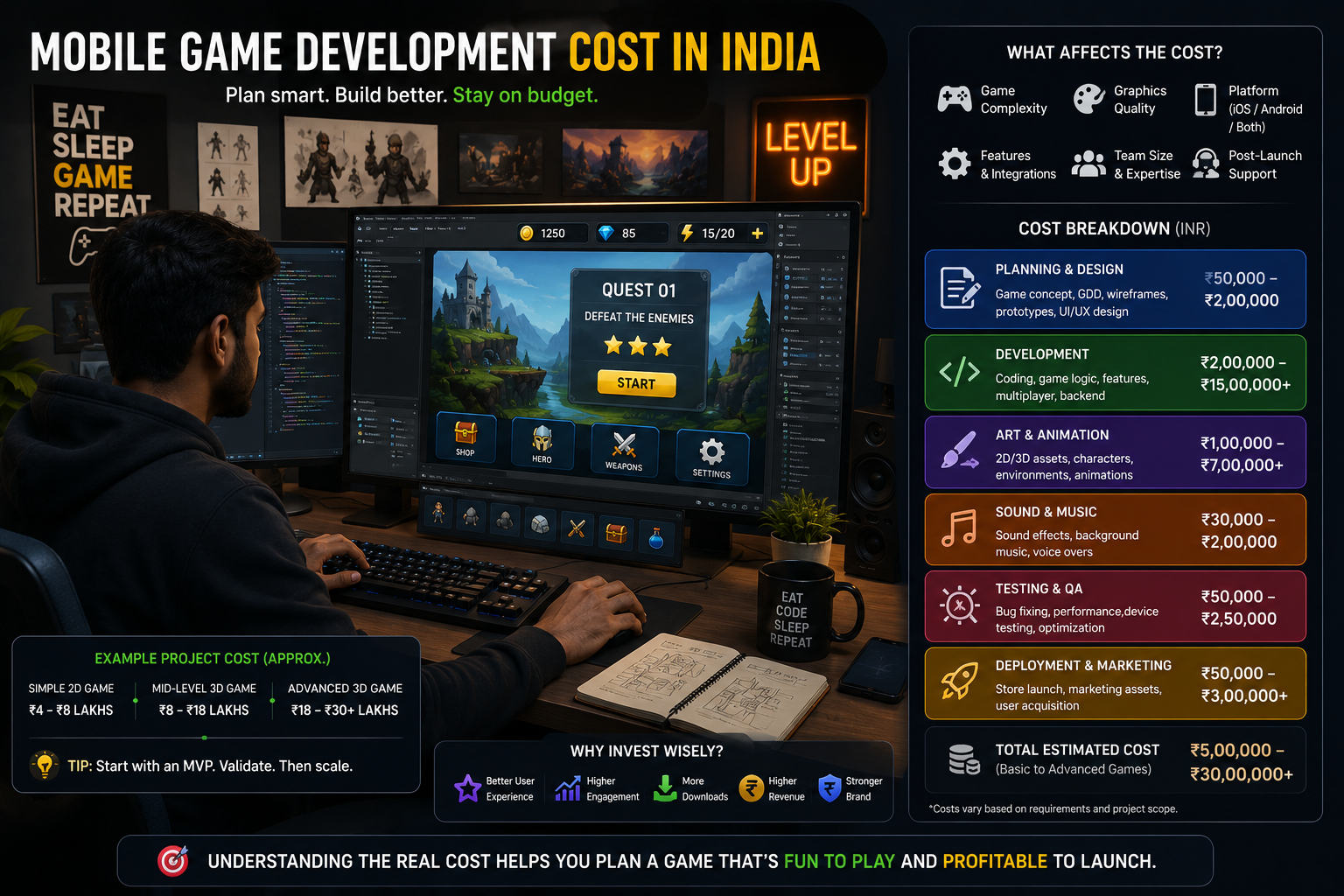
India has become one of the most active mobile gaming markets in the world, and building a game here can cost anywhere from a few lakhs to several crores. This guide breaks down the real numbers and explains exactly what your money goes into.
How Much Does It Cost to Develop a Mobile Game in India?
India now has over 500 million mobile gamers. That number alone tells you something important: the appetite for mobile games in this country is not just growing, it is accelerating. From teenagers playing battle royale games on budget Android phones in smaller towns, to working professionals spending money on strategy games during their commute, the audience is broad, passionate, and commercially significant.
This environment has created a very practical question for entrepreneurs, startup founders, and established businesses alike: how much does it actually cost to build a mobile game in India? The honest answer is that it depends on a number of specific factors, and any developer who throws a single number at you without asking a single question is either overconfident or not being straight with you.
This guide walks through the real cost drivers, the realistic budget ranges at each level of complexity, and the things you need to watch out for when planning your investment. There are no vague round numbers here. The goal is to give you a clear, ground-level picture so that you can plan intelligently before you speak with a single development team.
What actually drives the cost of a mobile game?
Before you can understand price ranges, you need to understand what you are actually paying for. Mobile game development is not a single task. It is a collection of distinct disciplines that must work together, and each one carries its own cost.
The first major cost driver is the game engine and platform target. If you are building for both Android and iOS simultaneously, the initial setup cost rises compared to a single-platform launch. Most development teams in India work with Unity or Unreal Engine. Unity is the dominant choice for 2D games, casual titles, and mid-range 3D projects because it is cost-efficient. Unreal Engine is used for graphically demanding projects and carries a higher production cost. The engine licensing terms and the team's familiarity with the technology both affect your final bill.
The second driver is the game's genre and mechanics. A word puzzle game with ten levels is fundamentally different from a real-time multiplayer strategy game. The more complex the game systems, the more developer hours are required to design them, code them, test them, and balance them. Physics-based gameplay, artificial intelligence for non-player characters, in-app purchase systems, and leaderboard infrastructure are all features that add meaningful time to the development cycle.
The third driver is the art and animation quality. This is where many first-time game developers badly underestimate their budget. High-quality character art, background environments, cut scenes, and smooth character animations require skilled artists who spend considerable time on each asset. The visual quality of your game is often the first thing a potential player judges in the app store, so cutting corners here frequently leads to poor download numbers regardless of how good the underlying game mechanics are.
The fourth driver is sound design and music. Background music, sound effects, and character voice work all contribute to the experience, and they are often treated as optional during initial budgeting. That is a mistake. A game that feels silent or uses poorly recorded audio will lose player retention far faster than a game with good audio design, even if the visuals are identical.
The fifth driver is backend infrastructure. If your game requires user accounts, multiplayer functionality, cloud saves, or real-time leaderboards, you need a backend server architecture to support it. This means writing APIs, setting up databases, handling security, and managing ongoing server costs after the game launches. Many lightweight games skip this entirely, but most mid-range and premium games need it.
The realistic cost breakdown by game type
Indian development studios and freelance teams have a wide range of pricing. The figures below represent realistic market rates for quality work in 2026. These are not the rates you will find by posting on a freelance platform and accepting the lowest bid. These are the rates associated with teams that follow proper processes, deliver tested code, and can be held accountable throughout a project.
Simple Casual Games: Rs. 3 lakh to Rs. 10 lakh
At this level, you are building something like a basic tap-based game, a simple puzzle title, or an educational game for children. The mechanic is usually a single, repeatable loop. The art style is often simple, with two-dimensional graphics and limited animation. These projects typically involve a small team of two to four people working for two to four months. Basic ad monetization through banners and interstitials is possible at this level, but anything more sophisticated adds time and cost.
At this budget, you can build a functional, well-tested game for a single platform. Cross-platform support for both Android and iOS simultaneously will push you toward the higher end of this range. The limitations are significant: limited levels, no multiplayer, no complex backend, and a visual style that relies on efficient 2D art rather than detailed 3D assets.
Mid-Range Games: Rs. 10 lakh to Rs. 50 lakh
This is the category where most serious independent game projects land in India. At this level, you can build a game with meaningful depth: multiple levels or stages, a progression system that keeps players coming back, better-quality character art, a proper soundtrack, and an in-app purchase economy. The development team typically involves five to ten people, including a dedicated game designer, at least two to three developers, an art team, and a quality assurance specialist.
Projects in this range take between four and twelve months depending on scope. This is also the level where backend infrastructure becomes necessary. If you want user accounts, social sharing features, or any form of online leaderboard, the backend adds approximately 15 to 25 percent to your overall budget. The art quality here can be genuinely polished, particularly for 2D games and stylized 3D titles. Attempting to reach the visual standard of a large studio game at this budget is not realistic, but achieving a look and feel that stands out in a mid-category app store search is absolutely achievable.
Complex and Premium Games: Rs. 50 lakh to Rs. 2 crore and above
Real-time multiplayer games, large open-world titles, battle royale formats, and games with console-quality 3D graphics belong in this category. Building something at this level requires a production team of 15 or more people, sustained over a development timeline of 12 to 36 months. The cost is driven primarily by art production, which can account for 40 to 50 percent of the total budget on visually ambitious projects.
At this investment level, you are not just building a game. You are building a live service product that requires post-launch content updates, server maintenance, community management, and ongoing development to keep the player base engaged. Budget accordingly for operational costs beyond the initial launch. Many project owners make the mistake of investing heavily in launch and then running out of money before the game can build a sustainable audience.
Hidden costs that most budgets overlook
The development cost is only part of the total investment required to bring a mobile game to market successfully. The following are costs that regularly surprise first-time game publishers, and accounting for them early will save you considerable stress.
App store fees are a starting point. Publishing on the Google Play Store requires a one-time registration fee of approximately 2,500 rupees. Publishing on Apple's App Store requires an annual developer account fee of around 8,000 rupees per year. These are minor costs on their own, but both platforms also take a percentage commission on every in-app purchase your game generates, typically 30 percent on transactions, which affects your revenue projections from day one.
Post-launch server costs are a recurring expense that many developers do not adequately plan for. If your game runs any backend infrastructure, those servers must be paid for every month, regardless of whether the game is generating revenue. On a modest multiplayer game, server costs for a few thousand active users can run between 15,000 and 60,000 rupees monthly depending on your architecture choices and traffic levels.
User acquisition is the cost that separates profitable games from ones that launch to silence. The mobile game market is saturated, and organic discovery on app stores alone is not sufficient for most titles. Running paid advertising campaigns to acquire players typically costs between 50 and 200 rupees per install depending on the game category and the platform you advertise on. If your monetization model relies on player retention and in-app purchases, you need a clear understanding of your expected revenue per user before you can determine a sensible acquisition budget.
Software licenses and third-party integrations add up quickly. Analytics SDKs, advertising networks, payment gateways, and crash reporting tools all require integration and sometimes carry licensing costs. While many basic tools are free, premium analytics and marketing automation platforms can cost several thousand rupees monthly for growing games.
How to choose the right development partner in India
India has a large pool of game development talent, spanning established studios in cities like Pune, Hyderabad, Bengaluru, and Mumbai, as well as smaller boutique agencies and individual freelancers distributed across the country. The challenge is not finding people willing to take on your project. The challenge is finding people who will deliver it at the standard your business requires.
One practical approach is to ask specifically for games that are currently live on the app stores, not just screenshots or design files. Download the actual game and play it for 20 minutes. Evaluate how it feels on your own device. Does it crash? Are the load times acceptable? Does the progression system hold your attention? A team that is proud of their live products will give you this list without hesitation.
Ask the team about their quality assurance process. Testing a mobile game is not simply playing it once on a single device. It involves systematic testing across multiple Android manufacturers, different iOS versions, low-end hardware, and unstable network conditions. Teams that skip this discipline produce games that get negative reviews for technical issues within the first 48 hours of launch, and recovering from that kind of public record on an app store is genuinely difficult.
Request a clear breakdown of the project timeline with defined milestones. A professional team will give you a phased plan: pre-production design and prototyping, core mechanic development, art production, backend integration, testing, and launch preparation. Each phase should have a clear deliverable that you can evaluate before the next phase begins. This structure protects your investment and gives you natural checkpoints to course-correct if something is not working as expected.
What your budget can realistically achieve in 2026
The mobile gaming industry in India has matured considerably over the past five years. Player expectations are higher than they were when the market was younger, and standing out in an increasingly competitive app store environment requires more investment in quality than it once did. That said, India's development costs remain significantly lower than equivalent talent in North America or Western Europe, which creates a genuine structural advantage for projects built here.
A well-planned project with a budget of 15 to 20 lakhs can produce a polished casual game that competes meaningfully in its category if the design fundamentals are solid and the monetization strategy is thought through from the beginning. A budget of 40 to 60 lakhs gives you the space to build something with genuine long-term potential, including proper backend infrastructure, a considered progression system, and a quality assurance phase that reduces post-launch technical problems.
What no budget can substitute for is a clear understanding of the player experience you are trying to create before a single line of code is written. The most common reason mobile game projects fail in India is not budget insufficiency. It is starting development without a well-defined game design document that answers the fundamental questions: who is this game for, how does the core loop feel after 10 minutes of play, and how does the game make money without frustrating the player into leaving. Time spent on these questions before the build begins is the most cost-effective investment you can make.
Conclusion: Know what you are building before you pay for it
There is no universally correct number for mobile game development in India. A Rs. 5 lakh game can outperform a Rs. 50 lakh game if it is designed with clarity and launched to the right audience. Conversely, an underfunded attempt at a complex multiplayer title will burn through resources without a viable product to show for it. The cost is not the most important variable. The most important variable is the clarity and realism of your plan.
Spend time writing out your game concept in detail before approaching development teams. Define your target audience, your monetization model, and the minimum set of features required for a first launch. Then get detailed quotes from at least three development partners, ask to see their live work, and choose the team that demonstrates they understand game design as a craft, not just software development as a service. That combination of preparation and partnership is what turns a mobile game budget into a mobile game that people actually play.
About NovaEdge Editorial Team
NovaEdge Digital Labs is a team of designers, developers, and strategists dedicated to pushing the boundaries of digital innovation in 2026.
Learn more about the team