MVP App Development: What It Is and Why Startups Should Start Small
NovaEdge Digital Labs
Lead Strategist
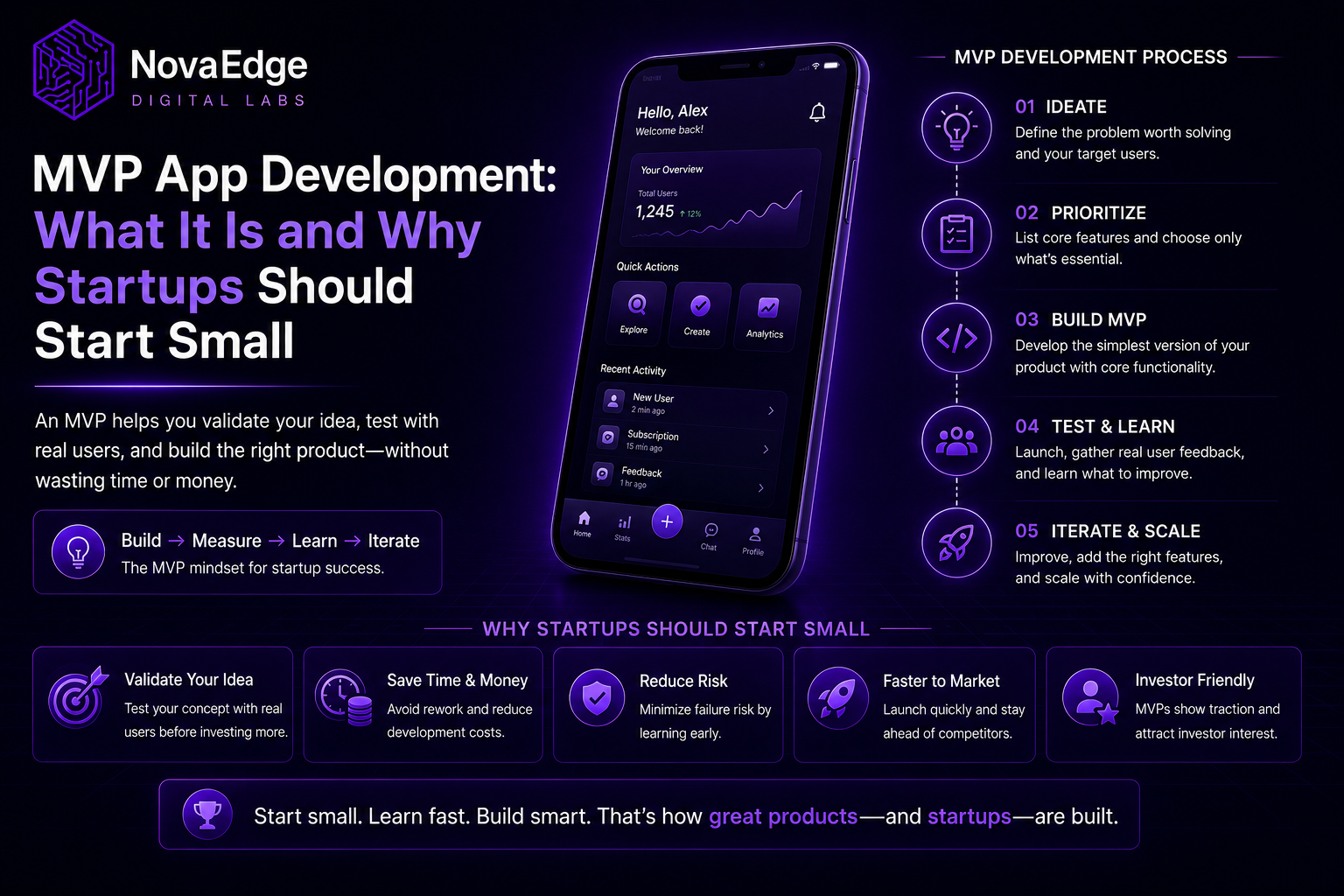
Building a new app is exciting, but trying to build a perfect product on day one is a common way to fail. A Minimum Viable Product (MVP) helps you launch faster, save capital, and validate your idea with actual users. Here is how to do it right.
When you get a new app idea, it is easy to design a platform that does everything: social networking, AI recommendations, payments, and multi-platform compatibility. You spend weeks planning every screen. But building this dream on day one runs into a harsh reality. Developing a large application is slow and expensive. By the time you launch, months have passed, your budget is exhausted, and you might find that users do not actually want the features you spent so much time building.
This is a common startup trap. Approximately 90% of startups fail, and premature scaling—building a product too large before validating the market—is a leading cause. To survive, you must start small. A Minimum Viable Product (MVP) is the simplest version of your product that solves a core problem for users. It is not about releasing a buggy product; it is about finding the absolute core value of your idea, packaging it simply, and getting it into the hands of real users as fast as possible.
What Is an MVP (And What It Is Not)?
A Minimum Viable Product is the simplest version of a product that still delivers value to customers and allows you to collect feedback. Look at the two key words:
Minimum means building only what is necessary to solve the problem. If your app is a food delivery service, the minimum version lets a user select a meal, pay, and get it delivered. It does not need live driver tracking, AI restaurant recommendations, or loyalty systems.
Viable means it must actually work and solve the problem. If a user tries to order food and the app crashes or the order is lost, the product is not viable. It fails to perform its basic job.
Consider the skateboard analogy. If your goal is to build a car, you do not start with a single wheel. A wheel is not functional. Instead, you start with a skateboard. It is simple and cheap, but functional—a user can move. Based on feedback, you add steering to make it a scooter, then a bicycle, and eventually a car. At every stage, the user has a working tool to solve their basic transportation problem while you learn from their behavior.
The High Cost of Building Too Big Too Soon
Why is starting with a full-scale app risky? It comes down to uncertainty. When you launch a startup, you operate on assumptions. You assume that users have a specific problem, that your app solves it, and that they will pay for your solution. If you build the complete app before testing these assumptions, you risk making costly mistakes.
First, you waste capital. Custom app development is expensive. Building a complex database, integrating third-party services, and designing dozens of screens can cost tens of thousands of dollars. If your assumptions are wrong, that money is gone. Starting small preserves your budget so you can adapt when you discover what users actually want.
Second, you lose time. A large app takes months to build. While you work in isolation, the market changes. Competitors might launch simpler versions of your idea first and capture the market. An MVP lets you launch in weeks rather than months, giving you a competitive advantage.
Third, you build unnecessary complexity. Every feature introduces bugs, higher maintenance costs, and a confusing interface. If you launch with thirty features and find users only use two of them, the other twenty-eight features are actively harming your product by distracting users and slowing down development.
Why Startups Must Start Small
Starting small with an MVP provides several direct advantages that can make the difference between a startup's survival and its failure.
1. Faster Validation with Real Data
The only real validation comes from user actions. When you ask potential customers if they would use your app, they usually say yes to be supportive. But there is a massive gap between saying you would use an app and actually downloading it, creating an account, and entering payment details. An MVP forces you to confront reality immediately by tracking actual user commitment.
2. Direct Feedback from Early Adopters
Your first users are your most important source of information. These early adopters experience the problem you are solving so intensely that they are willing to use a simple, unpolished tool. Because they care about the solution, they are highly motivated to give feedback. They will tell you what is missing, what is confusing, and what they love, helping you build your roadmap based on real user needs.
3. Efficient Allocation of Resources
Most startups fail because they run out of money. An MVP helps you allocate your resources efficiently. Instead of spending your entire budget on development, you spend a small portion to build the core feature. This leaves you with capital for marketing, customer support, and iteration. When you discover that a feature needs to change, you have the financial flexibility to rewrite the code.
4. Clear Value Proposition
When an app tries to do everything, it is hard to explain what it does. Your marketing message becomes diluted. By focusing on a single core feature, your value proposition becomes crystal clear. For example, if your app helps freelance designers write contracts in under two minutes, that is a compelling message. Once you win their trust, you can introduce other features like invoicing.
A Step-by-Step Guide to Planning Your MVP
Building a successful MVP requires a disciplined approach. You must resist the temptation to add extra features. Here is a step-by-step framework to keep your project on track.
Step 1: Define the Problem and the Audience. Who is your user, and what is their primary frustration? Write this down in one sentence. For example: 'Small business owners struggle to track expenses because existing accounting software is too complicated.' Every feature you build must address this frustration. If it does not, it does not belong in the MVP.
Step 2: Map the User Journey. Outline the steps users must take to achieve their goal. Keep this path as short as possible. For our expense tracker, the journey is: log in, snap a photo of a receipt, extract the total, and view a monthly total. You do not need custom reports or export options for the initial version. Focus entirely on making this core loop work perfectly.
Step 3: Prioritize Features. Write down all the features you want in your final product. Use the MoSCoW method to prioritize them into Must-Have, Should-Have, Could-Have, and Won't-Have. Your MVP should only contain features from the Must-Have category. These are critical to the core loop. Everything else goes into your backlog for future iterations.
Step 4: Choose Your MVP Type. Depending on your goals, choose from several types: Landing Page: A simple page explaining the concept to collect emails. Wizard of Oz: An interface that looks automated, but you perform the work manually behind the scenes. Concierge: A high-touch manual service provided directly to the customer to understand their needs. Single-Feature: A simple application that does one specific thing well.
Real-World Examples of MVPs That Succeeded
Many successful tech companies started as simple MVPs, proving you do not need a perfect product to build a massive business.
Airbnb: In 2007, the founders could not afford San Francisco rent. Seeing that hotels were fully booked for a conference, they set up a basic website showing their loft with three air mattresses and breakfast. They found three paying guests, validating the demand for home-sharing and launching Airbnb.
Dropbox: Building a reliable cloud storage service was a massive technical challenge. Instead of building the software first, the founder created a simple three-minute video demonstrating how the syncing technology worked and posted it online. Overnight, the waitlist grew from 5,000 to over 75,000, validating the demand and securing funding to build the actual product.
Uber: When Uber launched in 2010 as UberCab, it only worked in San Francisco and only let users request luxury black cars. It did not have live tracking on a map, fare splitting, or pool rides. It was a simple tool to solve a specific problem: booking a ride without calling a taxi company. Once they proved people loved the service, they expanded the platform.
Transitioning from MVP to Full Product
Releasing your MVP is only the beginning. Once live, transition into a cycle of learning and iteration. Focus on quantitative metrics: sign-ups, retention, and drop-off points. If users sign up but never return, your core value proposition might be clear, but the product is not delivering enough value.
Combine this with qualitative feedback. Talk to active users. Ask why they use the app and what they would change. This information is your guide for the next phase. Treat every new feature as a mini-MVP. Validate the need before writing code, ensuring your app remains fast, simple, and aligned with user needs as you scale.
Conclusion and Action Plan
Building a startup is a race against time and capital. The faster you learn what your customers want, the more likely you are to succeed. Trying to build a perfect, feature-rich application on day one is a high-risk strategy that often leads to exhausted budgets. Starting small with an MVP protects your resources, launches faster, and builds your product on real user data rather than assumptions.
Identify the core problem, build the simplest tool to address it, and get it into the hands of users. The feedback you receive will be the roadmap for your success. At NovaEdge Digital Labs, we help startups design, build, and launch high-performing web and mobile MVPs. We focus on clean architecture, fast load times, and intuitive design, helping you validate your idea quickly and scale efficiently. Contact us to discuss how we can build your digital product.
Frequently Asked Questions
About NovaEdge Digital Labs
NovaEdge Digital Labs is a team of designers, developers, and strategists dedicated to pushing the boundaries of digital innovation in 2026.
Learn more about the team