Next.js vs WordPress: Which Platform Should Your Business Choose?
NovaEdge Tech Team
Lead Strategist
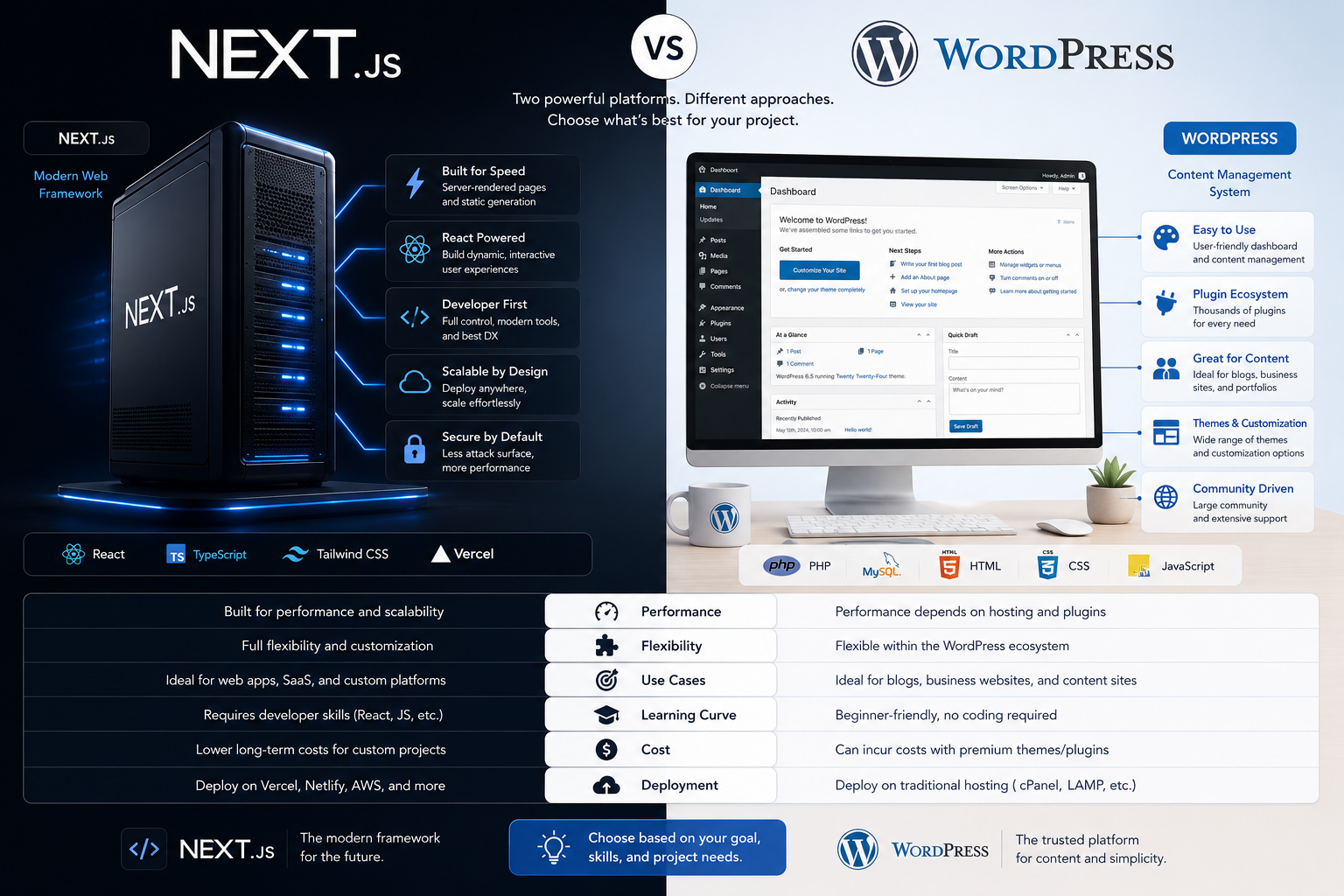
Choosing the right platform to build your website is one of the most consequential technical decisions your business will make. The platform you select dictates not just how your website looks, but how fast it loads, how securely it handles customer data, and how easily your team can update content. Today, the conversation often comes down to two major contenders: WordPress, the seasoned veteran of content management, and Next.js, the modern framework redefining web performance.
Choosing the foundation for your company website is one of the most critical technical decisions you will face as a business owner or technical leader. This choice determines far more than just how your pages look on a screen or what colors you can use. The platform you select controls how quickly your site loads for impatient visitors, how securely it protects sensitive customer data, and how efficiently your internal teams can publish new material. A poor decision can lead to years of technical debt, frustrating maintenance routines, and lost revenue due to poor performance. Conversely, the right decision creates a scalable asset that grows alongside your business.
For years, this conversation was relatively straightforward because the market was dominated by one clear leader. However, the landscape of web development has shifted dramatically in recent times. A modern challenger has emerged to disrupt the status quo, offering a completely different architecture designed to solve the bottlenecks of older systems. Today, businesses find themselves caught in a serious debate between two distinct approaches to building for the web.
On one side, you have WordPress, the seasoned and familiar veteran of content management that powers a massive portion of the internet. On the other side, you have Next.js, a modern framework that is redefining what is possible regarding web performance and user experience. Deciding between these two requires a clear understanding of your current resources, your long-term digital strategy, and how each platform operates under the hood. This comprehensive guide will break down everything you need to know to make an informed decision for your business.
Understanding WordPress: The Traditional Content Giant
To understand the debate, we must first look at how WordPress operates. Launched over two decades ago as a simple tool for writers, it has evolved into a massive Content Management System capable of running everything from personal portfolios to complex corporate hubs. Its sheer market share is a testament to its flexibility and accessibility. When people think of building a website, WordPress is often the first name that comes to mind.
At its core, WordPress uses a monolithic architecture. This technical term simply means that the backend of your website, where all your text and images live in a database, is tightly connected to the frontend, which is the visual layout the visitor sees. When someone types your web address into their browser, the server has to wake up, ask the database for the right information, assemble the page using your chosen design template, and then send the finished product to the user.
While this process happens in a matter of milliseconds, it requires active server processing power for every single person who visits your site. This traditional way of serving web pages was revolutionary in the early days of the internet, but as web traffic grows and user expectations for instant loading times increase, this architectural style can become a significant bottleneck.
Where WordPress Shines Brightest
The primary reason WordPress remains incredibly popular is its low barrier to entry. You do not need a degree in computer science to get a functional website off the ground. The administrative dashboard is highly intuitive, allowing marketing teams, writers, and store owners to publish articles, upload product images, and edit copy without ever needing to look at a single line of code. This independence empowers teams to move quickly.
Furthermore, the WordPress ecosystem is unparalleled in its scope. There are tens of thousands of pre-built templates and functional plugins available. Whether you need to add a complex contact form, integrate a sophisticated newsletter signup, or transform your site into a fully functioning digital storefront, there is almost certainly a plugin available to do the job. This massive library of tools makes the initial launch of a WordPress site incredibly fast and highly cost-effective.
Because the platform has been around for so long, finding help is also very easy. The talent pool of developers, designers, and agencies who specialize in WordPress is enormous. If you run into a problem, someone else has likely encountered it and documented a solution online. This widespread familiarity reduces the risk of being locked into a single specialized agency for your maintenance needs.
The Hidden Costs of a Monolithic System
However, this immense flexibility and reliance on third-party plugins come with significant trade-offs. As your business grows and you add more features to your site, you will naturally install more plugins. Each piece of additional software adds weight to your website. Over time, this accumulation leads to severe performance degradation. Your website becomes sluggish, pages take longer to load, and visitors abandon your site out of frustration before they even read your message.
Security is another major concern that keeps business owners awake at night. Because WordPress is the most popular platform on the planet, it is a constant target for malicious attacks. The vast majority of these security breaches do not occur in the core software itself, but rather in outdated or poorly coded plugins created by independent developers. Keeping a WordPress site secure requires constant vigilance, daily software updates, and proactive security monitoring.
Finally, making significant structural changes to a WordPress site can be fragile. Because the frontend and backend are intertwined, altering a piece of code to change a visual layout can inadvertently break a backend function. This fragility means that scaling a highly customized WordPress site often requires expensive, specialized hosting and continuous developer intervention to keep everything running smoothly.
Understanding Next.js: The Modern Performance Engine
Next.js represents a completely different philosophy of web development. Built on top of React, a powerful tool created for building user interfaces, Next.js provides the infrastructure needed to construct highly interactive and incredibly fast web applications. It is the tool of choice for engineering teams that want absolute control over how a website looks and performs.
Unlike the monolithic structure of WordPress, Next.js is designed for a headless architecture. In a headless setup, the frontend presentation layer is entirely separated from the backend database. Your content still lives in a database or a specialized content management system, but Next.js retrieves that data through communication bridges called APIs. It takes that data and constructs the final web pages independently.
The defining feature of Next.js is how it handles these web pages. Instead of building the page from scratch every time a user requests it, Next.js can pre-build your pages into static files during the development process. When a user visits your site, these ready-made files are served instantly from a global network of servers. The server does not have to think or assemble anything; it simply hands the user the finished file. The result is a blazing-fast experience.
The Power of Next.js for Business
The most compelling advantage of Next.js is uncompromised speed. In the modern digital economy, every second of loading time directly impacts your bottom line. Faster websites retain more visitors, convert higher percentages of leads, and rank significantly better in search engine results. Because Next.js serves pre-rendered static files, it provides a foundation of incredible speed right out of the box.
Security is also inherently stronger with this architecture. Because the frontend is decoupled from the backend database, there is no direct connection for attackers to exploit. Even if a malicious actor finds a vulnerability in the presentation layer, they cannot reach your sensitive customer data or administrative controls. This structural separation provides peace of mind for businesses handling critical information.
Furthermore, developers have absolute freedom to customize the user interface. You are not restricted by the structural limitations of a pre-built theme. Your engineering team can build precisely what your brand requires, incorporating complex animations, seamless page transitions, and highly interactive elements that feel more like a native mobile application than a traditional website.
The Trade-offs of a Modern Architecture
The barrier to entry for Next.js is substantially higher than WordPress. It is a specialized tool designed for professional software engineers. You cannot launch a Next.js site over the weekend by simply purchasing a theme and clicking a few buttons. It requires a deep understanding of modern programming languages, cloud infrastructure, and advanced deployment pipelines.
Consequently, the initial financial investment is much higher. You must hire experienced developers to build the application and connect it to a headless content management system so your marketing team can actually write and publish articles. While the ongoing maintenance costs might decrease over time, the upfront commitment required to get the project off the ground is a significant hurdle for smaller organizations.
Additionally, because Next.js separates the frontend from the backend, the content editing experience depends entirely on which headless system you choose to integrate. While modern headless options offer clean and organized interfaces, setting them up to match the effortless, integrated publishing experience of WordPress requires deliberate and careful engineering effort during the build phase.
Head-to-Head Comparison: Evaluating the Key Metrics
To determine the best fit for your specific business, it helps to evaluate how these two platforms stack up against the operational metrics that matter most to your daily success.
Performance and Load Times
Next.js wins this category decisively. Its core architecture is explicitly designed to minimize load times by serving pre-rendered pages from a global network. While a traditional site can be optimized to run fast, it requires continuous technical effort, expensive premium hosting, and aggressive caching strategies to come close. Next.js provides a massive structural advantage for speed from the very beginning.
Search Engine Optimization Strategy
Both platforms offer strong capabilities for search engine optimization, but they achieve results through entirely different mechanisms. Traditional systems rely heavily on external plugins to manage meta tags, generate sitemaps, and analyze content readability. These tools are excellent and incredibly user-friendly for marketing teams. Next.js excels because search engines strongly favor websites that load instantly and serve clean, fully-rendered code. If technical performance is the primary driver of your search strategy, Next.js provides a distinct edge.
Total Cost of Ownership
The financial models for these platforms are practically inverted. Traditional monolithic systems have a very low initial setup cost. You can launch a functional site on a modest budget. However, as your site grows, the ongoing costs for maintenance, premium hosting, and constant security interventions can become surprisingly high. Next.js requires a major upfront investment in engineering talent to build the custom application. However, hosting static assets is extremely cheap, and maintaining a well-architected application often requires far less ongoing intervention, making it highly cost-effective in the long run.
The Hybrid Approach: Headless WordPress
It is crucial to understand that this does not have to be a strictly binary decision. Many mid-market and enterprise companies are adopting a hybrid approach to get the best of both worlds. In this scenario, the marketing team continues to use the familiar and intuitive WordPress dashboard to write articles, upload images, and manage the content schedule. They keep the interface they already know and love.
However, instead of allowing that system to render the final webpage, an engineering team builds a custom Next.js frontend. This modern frontend communicates quietly with the backend, retrieves the content, and handles all the visual presentation for the visitor. This approach ensures that your marketing operations are never disrupted, while dramatically improving the speed, security, and user experience for your audience. It requires an initial engineering investment, but it bridges the gap perfectly.
When Should Your Business Choose WordPress?
Traditional content management systems are far from obsolete; they remain the absolute best choice for a wide variety of business models. You should confidently choose this route if your primary business function relies on publishing large volumes of written content quickly and frequently. It is the ideal environment for digital magazines, traditional corporate publications, and businesses where the marketing department needs to operate entirely independently of the engineering team.
Additionally, if your budget for initial web development is limited, this traditional approach provides the fastest and most practical route to a professional web presence. Small local businesses, early-stage startups testing an idea, and organizations that rely heavily on off-the-shelf software will find this ecosystem incredibly accommodating and perfectly suited to their immediate needs.
When Should Your Business Choose Next.js?
Next.js is the strategic choice for businesses that treat their website as a core digital product rather than just a digital brochure. If uncompromised performance directly impacts your ability to generate revenue—such as in large-scale online retail, software applications, or highly competitive digital markets—this modern framework provides the speed and reliability necessary to maximize your conversion rates and outpace your competitors.
It is also the right choice if your brand requires a highly customized user interface with complex interactive features that simply cannot be achieved with standard templates. Enterprise organizations handling sensitive data, or those expecting massive and unpredictable spikes in traffic, will benefit tremendously from the security and scalability inherent in a decoupled architecture. Choosing this path assumes you have the budget and the vision to support a dedicated engineering effort.
Conclusion: Making the Strategic Choice
There is no single correct answer in the debate between these two powerful technologies. The ideal choice depends entirely on the specific constraints, financial resources, and long-term goals of your organization. Neither platform is inherently superior; they are simply tools designed to solve different sets of problems for different types of businesses.
Traditional content management democratizes web development, offering an accessible and cost-effective platform that excels at publishing. It is a highly pragmatic choice for countless organizations. Modern frameworks represent a strategic investment in the highest tiers of performance, security, and scalability. They are designed for businesses ready to treat their digital presence as a custom-engineered software product.
By carefully evaluating your current budget, the technical expertise available to your team, and the specific role your website will play in driving your business forward over the next five years, you can confidently select the foundation that will best support your continued growth and digital success.
Frequently Asked Questions
About NovaEdge Tech Team
NovaEdge Digital Labs is a team of designers, developers, and strategists dedicated to pushing the boundaries of digital innovation in 2026.
Learn more about the team