Static Website vs Dynamic Website: Which One Do You Need?
Amit Kumar Raikwar
Lead Strategist
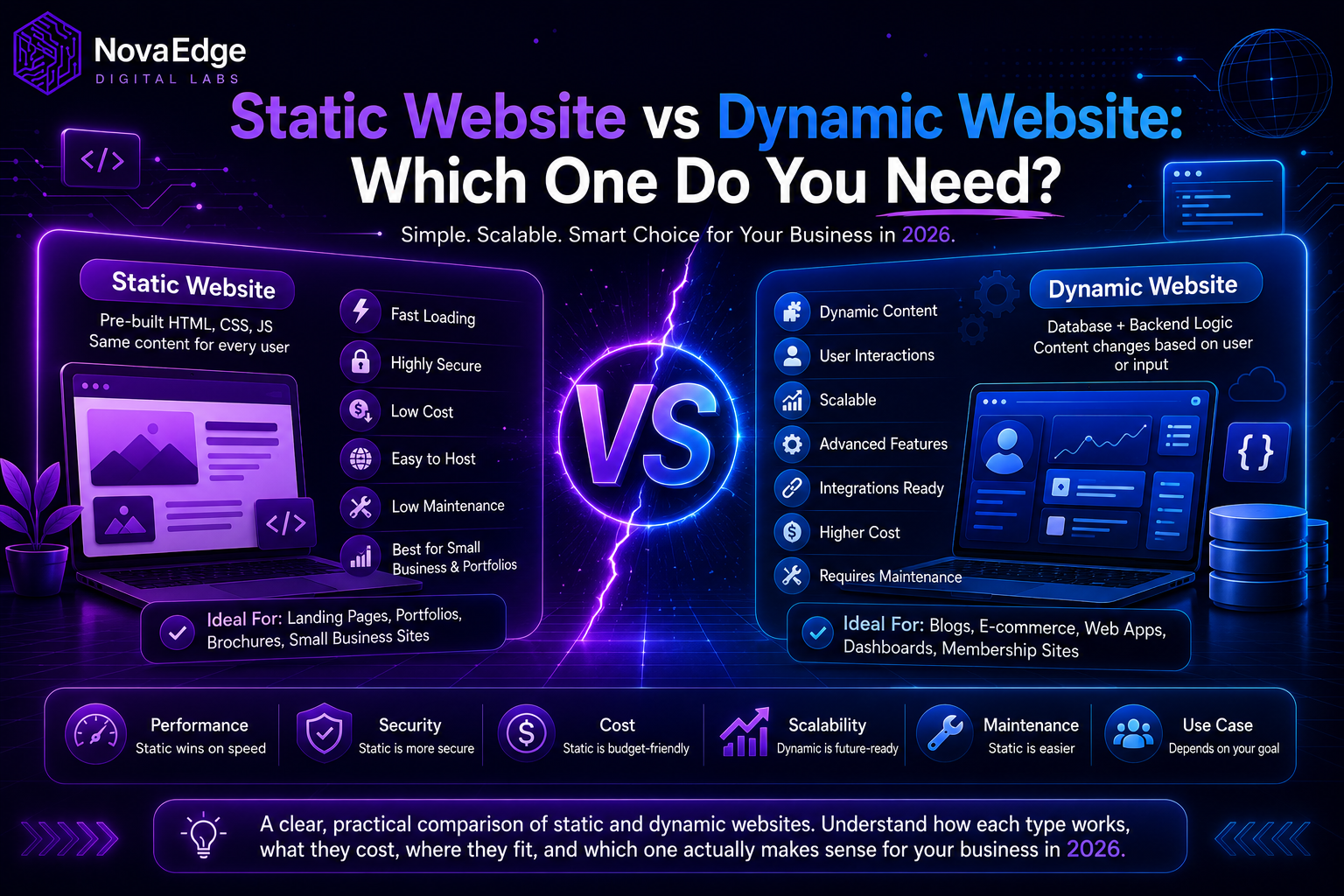
Every website on the internet falls into one of two camps — static or dynamic. The difference is not cosmetic. It affects your speed, your costs, your security, and what your site can actually do. This guide breaks down both types so you can pick the one that fits your business.
You are about to get a website built. Or maybe you already have one and it is not working the way you expected. Either way, someone has probably thrown the terms 'static website' and 'dynamic website' at you, and you are left wondering what the actual difference is and which one your business should have.
The distinction matters more than most people realise. It affects how fast your website loads, how much it costs to run, how secure it is, and what it can actually do for your visitors. Pick the wrong type and you either end up overpaying for features you never use, or you end up stuck with a site that cannot do the one thing your business needs it to do.
This post breaks down both types in plain language, explains the trade-offs honestly, and helps you figure out which one fits your specific situation.
What a Static Website Actually Is
A static website is made up of fixed files — HTML, CSS, and sometimes JavaScript. When someone visits your site, the server sends those files directly to their browser. That is the entire transaction. The server does not consult a database, does not run any logic, and does not assemble the page on the spot. It just hands over what was already prepared.
Think of it like a printed brochure. Every person who picks it up sees the same information. If you want to change something — a phone number, a new service, a different photo — someone has to redesign the brochure and print a new batch. On a static website, that means a developer has to edit the code files, update the content, and re-deploy the site.
That might sound limiting, and for certain use cases it is. But for many businesses, this simplicity is not a weakness. It is the whole point.
What a Dynamic Website Actually Is
A dynamic website builds its pages in real time. When a visitor lands on a page, the server receives the request, runs some code, pulls information from a database, assembles everything into a page, and sends the result to the browser. The content can change depending on who is visiting, what they have searched for, whether they are logged in, what time of day it is, or a hundred other variables.
Amazon is a dynamic website. The homepage you see is different from the one I see because it is built on the fly based on our browsing history, location, and purchase patterns. Facebook is dynamic. Your banking portal is dynamic. Any website where you log in, submit data, see personalised content, or interact with a system behind the scenes is dynamic.
Dynamic websites require a backend — a server running code, a database storing information, and often an admin panel or content management system that lets non-technical people update the site without touching code.
Speed and Performance
Static websites are inherently faster. Since the pages are pre-built files sitting on a server, delivering them to a visitor is about as fast as serving a file can get. There is no processing step. No database queries. No waiting for server-side code to finish running. The page arrives almost instantly.
You can push this even further by serving static files through a CDN — a content delivery network that caches your pages on servers around the world. A visitor in Mumbai gets served from a nearby node. A visitor in London gets served from one closer to them. Response times drop to near-zero.
Dynamic websites are slower by nature because every page request involves computation. The server has to receive the request, process it, query the database, assemble the page, and then send it. Good development practices, caching strategies, and powerful hosting can narrow this gap significantly, but a dynamic site will never match the raw speed of a static file being served from a CDN.
Speed is not a vanity metric. Google uses page load time as a direct ranking factor. Visitors leave if a page takes more than three seconds to load. For a business website, every millisecond matters.
Cost of Building and Running Each Type
Static websites are cheaper across the board. They cost less to build because the architecture is simpler — no backend logic, no database design, no admin panel development. They cost almost nothing to host because static files can be served from platforms like Netlify, Vercel, or GitHub Pages for free or for a negligible monthly fee. Maintenance costs are minimal because there are no server-side dependencies to update, no database to manage, and fewer security patches to worry about.
Dynamic websites cost more at every stage. The development is more complex because you are building two systems — the frontend that visitors see and the backend that powers it. Hosting requires actual server resources, which means monthly costs that scale with traffic. Databases need monitoring and backups. The CMS or admin panel needs security updates. If you are running WordPress, you are dealing with plugin updates, compatibility issues, and the constant threat of vulnerabilities in third-party code.
That said, spending more on a dynamic website is not wasted money if you genuinely need the features it provides. The issue arises when businesses pay for dynamic infrastructure they never actually use.
Security
Static websites have a much smaller attack surface. There is no server-side code to exploit, no database to breach, no login system to brute-force, and no CMS admin panel to compromise. The most a hacker can target is the hosting account itself or the DNS configuration, both of which are relatively straightforward to secure.
Dynamic websites are inherently more vulnerable because they have more moving parts. Every database connection is a potential entry point. Every user input field — contact forms, login pages, search bars — can be exploited if not properly secured. Content management systems like WordPress are frequent targets precisely because they are so widely used, and many site owners fail to keep their installations and plugins updated.
This does not mean dynamic websites are unsafe. It means they require active, ongoing security practices. A well-built and properly maintained dynamic website can be very secure. But a neglected one is a sitting target.
Content Updates and Management
This is where static websites show their biggest limitation. Every time you want to change a line of text, swap an image, or add a new page, someone with technical knowledge has to edit the source files and redeploy the site. For a business that updates its website once a quarter, this is barely an inconvenience. For a business that publishes content daily or manages hundreds of product listings, it is a dealbreaker.
Dynamic websites solve this with content management systems. WordPress, Strapi, Sanity, or a custom-built admin panel lets your team update content, upload images, manage products, and publish blog posts without ever opening a code editor. The people running your business can manage the website directly, which reduces dependency on developers for routine changes.
There is a middle ground worth noting. Modern static site generators like Next.js, Hugo, and Astro can pull content from a headless CMS, build the pages at deploy time, and serve them as static files. You get the ease of a CMS with the performance and security benefits of a static site. This approach is increasingly popular and worth exploring if you want the best of both worlds.
When a Static Website Is the Right Choice
A static website makes sense when the content does not need to change often and there is no requirement for user interaction beyond basic contact forms. Here are the scenarios where static is not just adequate but actually the better option.
- Business brochure sites. A local accounting firm, a law office, a construction company — businesses that need an online presence with their services, contact details, and a few pages about their team. The content changes maybe twice a year. A static site serves this perfectly.
- Personal portfolios. Designers, photographers, developers, and freelancers who want to showcase their work. The portfolio updates periodically, not daily. Speed and visual presentation matter far more than backend features.
- Landing pages. A single-purpose page built for a marketing campaign, a product launch, or an event. These pages are meant to load fast, look sharp, and convert visitors into leads. Static is ideal.
- Documentation sites. Technical documentation, help centres, and knowledge bases where the content is authored by a team and published at intervals. Static site generators handle this beautifully.
- Startups validating an idea. If you are testing whether a business concept has legs, spending three months building a full-stack dynamic website is premature. Get a static site live in a week, start collecting leads, and build the complex system later when you know what you actually need.
When a Dynamic Website Is the Right Choice
A dynamic website becomes necessary when the site needs to do things that fixed files simply cannot handle. If any of the following describe your situation, you need dynamic.
- E-commerce stores. If you are selling products online — managing inventory, processing payments, handling shipping calculations, and letting customers track orders — that is a dynamic system. Shopify, WooCommerce, custom-built stores, all dynamic.
- Websites with user accounts. If visitors need to register, log in, save preferences, track orders, submit applications, or access personalised dashboards, the site must interact with a database. That is dynamic by definition.
- Content-heavy platforms. News websites, blogs with multiple contributors, recipe sites with thousands of entries, real estate listings — any platform where content is published frequently and needs to be searchable, filterable, and categorised.
- Web applications. Anything that behaves more like software than a website. Project management tools, booking systems, SaaS platforms, CRM portals, online learning platforms — these are all dynamic applications.
- Sites with real-time features. Live chat, notifications, real-time dashboards, collaborative editing — anything that needs to update without the user refreshing the page requires a dynamic backend, often with WebSocket connections.
The Mistake Most Businesses Make
The most common mistake is overbuilding. A business that needs a five-page informational website ends up with a WordPress installation, a database, a hosting plan that costs ten times what a static site would, and a CMS they log into once a year. They pay for complexity they never use, and that complexity introduces maintenance overhead and security risks that serve no purpose.
The second most common mistake is underbuilding. A business that plans to sell products online, manage customer accounts, and publish weekly content tries to do it all with a static site and a collection of third-party widgets glued together. The result is a fragile, limited system that breaks whenever a requirement changes.
The right answer is not always static and it is not always dynamic. It depends entirely on what your website needs to do today and what you can reasonably expect it to need within the next twelve to eighteen months.
A Practical Way to Decide
Before you talk to a developer or an agency, sit down and answer these four questions honestly.
- How often will the content on the site change? If the answer is rarely, static works. If the answer is daily or weekly, you need a CMS, which means dynamic or a static site with a headless CMS.
- Do visitors need to log in, submit data, or see personalised content? If yes, you need dynamic. There is no workaround for this with a purely static setup.
- What is my budget for hosting and maintenance? If you want to keep ongoing costs near zero, static is your path. If you can invest in proper hosting and regular maintenance, dynamic becomes viable.
- Will I need to scale this significantly in the next year? If the site is going to grow from five pages to five hundred, or from zero users to ten thousand registered accounts, plan for dynamic from the start. Migrating later is possible but never painless.
Your answers to those questions will point you clearly in one direction. If you are still uncertain after that, a good web development team can help you map your specific needs to the right architecture — and an honest one will tell you when the simpler option is genuinely sufficient.
The Bottom Line
Static and dynamic are not labels of quality. A static website is not cheap and a dynamic website is not premium. They are fundamentally different tools built for different jobs. A static site that does exactly what a business needs is a far better investment than a dynamic site packed with features nobody asked for.
Understand what your website needs to accomplish. Match that to the right type. And do not let anyone talk you into paying for infrastructure you will never use — or, equally, into cutting corners that will cost you more to fix later.
At NovaEdge Digital Labs, we help businesses figure out the right type of website before a single line of code gets written. Whether you need a fast, focused static site or a full-featured dynamic platform, we build what actually fits your situation — not what pads a proposal. If you want a straight conversation about what your project needs, reach out. No jargon, no overselling, just practical advice and honest execution.
Frequently Asked Questions
About Amit Kumar Raikwar
NovaEdge Digital Labs is a team of designers, developers, and strategists dedicated to pushing the boundaries of digital innovation in 2026.
Learn more about the team