Vibe Coding in 2026: How AI Coding Agents Like Antigravity, Cursor, and Claude Code Are Changing Software Development
NovaEdge Digital Labs
Lead Strategist
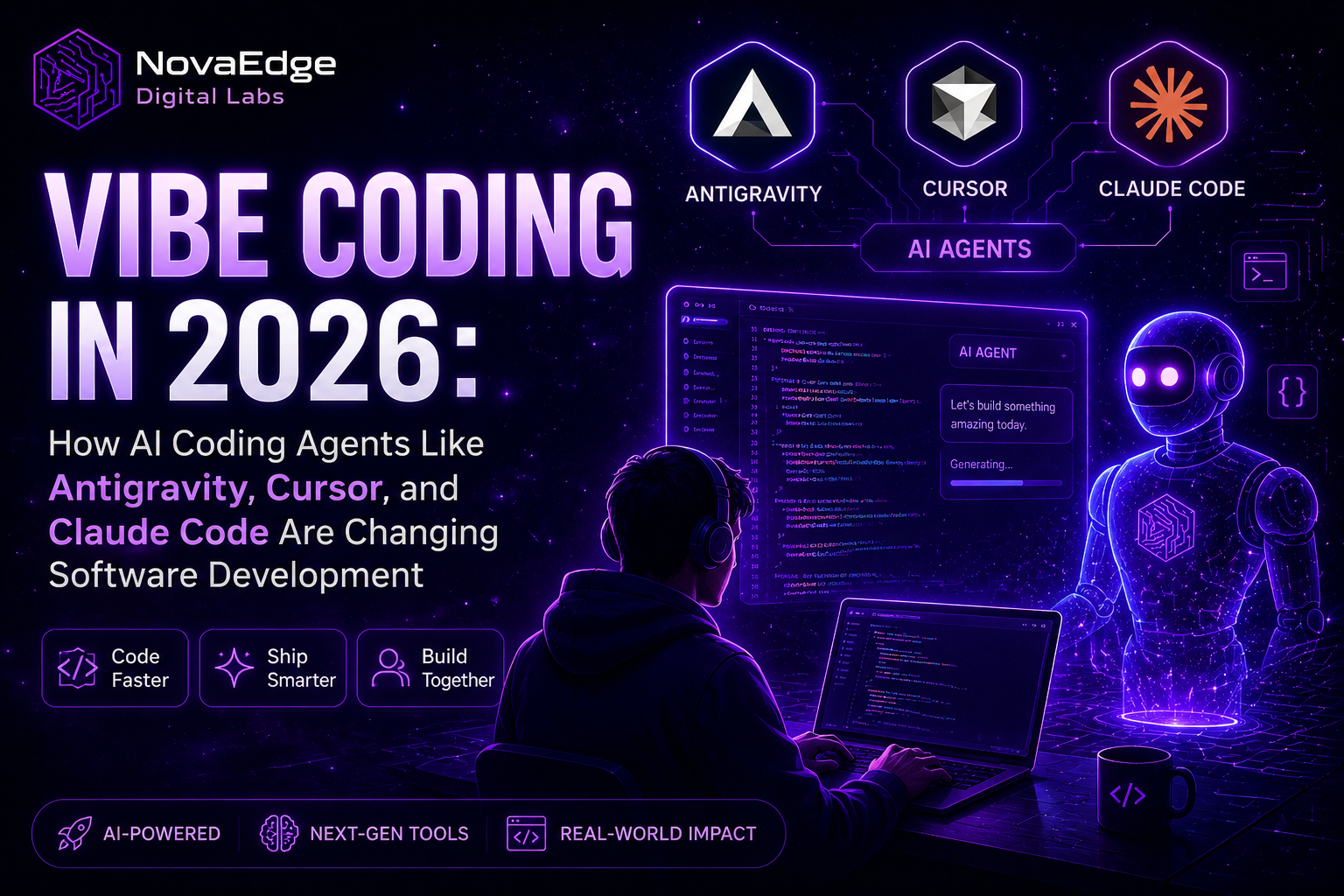
Discover what vibe coding is, compare top AI coding agents like Antigravity AI, Cursor, and Claude Code, and learn how to build apps faster in 2026.
If you've spent any time in the developer ecosystem lately, you've probably heard the term "vibe coding." It sounds like a buzzword—something a tech influencer would say while sipping a matcha latte. But in 2026, vibe coding represents a profound, fundamental shift in how software gets built. We've moved far beyond the era of autocomplete and simple boilerplate generation. Today, we are collaborating with autonomous AI coding agents that understand context, execute terminal commands, read documentation, and write entire features from a simple set of natural language instructions.
For solo founders, indie developers, and small agencies, this is nothing short of a superpower. Building an app no longer requires writing every single line of code from scratch or wrestling with obscure webpack configurations for three days. Instead, you describe the "vibe"—the architecture, the user experience, the data flow—and your agent brings it to life.
In this post, we're going to dive deep into what vibe coding actually means, compare the powerhouse tools driving this movement (like Antigravity AI, Cursor AI, and Claude Code), and explore exactly how you can leverage AI app development in 2026 to build better software, faster.
What is Vibe Coding?
The term vibe coding was coined around 2025 by developers who noticed a shift in their workflows. They were no longer typing out character by character; instead, they were acting as high-level directors. You set the constraints, define the goals, give the AI a sense of what the feature should look and "feel" like, and the AI writes the implementation.
But what does this actually mean in practice?
Vibe coding is essentially spec-driven development powered by natural language. It is the process of describing your intent to an AI coding agent, allowing it to write, refactor, and test the code, while you focus on the architecture and the user experience. You aren't just giving the AI a prompt like "write a React component." You are telling the AI: "Create a sleek, dark-mode SaaS dashboard component using Next.js App Router, fetch the user data from Supabase, animate the loading state with Framer Motion, and make sure to use TailwindCSS. If you hit a hydration error, check the layout file and fix it."
The AI agent then acts on this prompt, generating the files, installing the necessary npm packages, and even running the development server to check for errors.
Why the Shift?
In previous years, AI coding assistants (like early versions of GitHub Copilot) were essentially smart autocompletes. They guessed the next line of code. But an agentic IDE goes much further. It has agency. It can read your entire codebase, execute terminal commands, create files, and fix its own bugs. This shift from "assistant" to "agent" is the bedrock of vibe coding.
Top AI Coding Agents in 2026 — Quick Comparison
The landscape of AI coding agents has exploded, but a few heavyweights have defined the standard for 2026. If you're looking to build apps with AI, choosing the right tool for your workflow is crucial. Here is a breakdown of the top players.
1. Antigravity AI (by Google DeepMind)
Antigravity is arguably the most powerful agent-first environment available today. Designed by Google DeepMind, it operates as a fully autonomous system that lives in your terminal, editor, and browser.
2. Cursor AI
Cursor was one of the pioneers of the AI-first code editor movement and remains an absolute favorite among indie developers. It is a fork of VS Code, meaning all your extensions and themes work out of the box.
3. Claude Code (by Anthropic)
Anthropic's Claude Code is a CLI-based agent that plugs directly into your existing workflow. Powered by Claude 3.5 (and later models), it brings Anthropic's world-class reasoning capabilities directly into your terminal.
Summary Comparison
Real Workflow Example: Building a SaaS Dashboard
To truly understand vibe coding, let's look at how a solo founder might use an AI agent to build a new feature. Let's say you want to build a SaaS analytics dashboard.
Step 1: The Spec (Setting the Vibe)
Instead of writing an HTML boilerplate, you write a detailed Markdown file (a specification).
Prompt: "We are building a React analytics dashboard for our SaaS. Use Next.js, Tailwind CSS, and Recharts. Create a main layout with a sidebar navigation. In the main view, add three KPI cards (Revenue, Active Users, Churn) and a line chart showing revenue over the last 30 days. Use dummy data for now, but structure the components so they can easily accept an API prop."
Step 2: Execution
You feed this spec to an agent like Antigravity. The agent reads the instructions, creates the components/Dashboard.jsx file, creates the components/Sidebar.jsx file, and updates the main page.jsx. It even runs npm install recharts in the background.
Step 3: Iteration
You look at the result. It's functional, but the vibe is off. The colors are too generic.
Prompt: "The layout is good, but the design feels dated. Update the Tailwind classes to use a modern, glassmorphism aesthetic. Add subtle hover states to the KPI cards and change the chart line color to a vibrant neon purple."
The AI parses the entire component tree and updates the CSS classes instantly. What would have taken a developer two hours of tweaking CSS properties took four minutes. This is vibe coding. You are the architect; the AI is the typist.
Why This Matters for Startups & Small Teams in India
India has one of the fastest-growing and most dynamic startup ecosystems in the world. From bootstrapped SaaS founders in Bengaluru to creative digital agencies in Indore, speed and capital efficiency are everything.
If you're building a tech product in India today, ignoring AI coding agents is like choosing to dig a trench with a spoon when there's an excavator sitting right next to you.
Check out how NovaEdge Digital Labs helps businesses scale with modern web development solutions
Common Mistakes / Things to Watch Out For
As magical as vibe coding feels, it is not without its pitfalls. No-code vs AI coding is a common debate, but remember: AI coding still produces code, and that code must be maintained.
The Future — Where This Is Heading in 2026 and Beyond
As we move deeper into 2026, the distinction between "developer" and "manager" is blurring. Agentic workflows are becoming the industry standard. We are seeing the rise of AI-first meta-frameworks—tools designed specifically to be manipulated by AI agents rather than human fingers.
We will see AI agents that don't just write code, but also manage cloud infrastructure, monitor production logs, and automatically deploy hotfixes when they detect an anomaly. The focus of the human developer is shifting from syntax and logic to system design, user psychology, and business value.
Conclusion
Vibe coding is not a fad; it is the new reality of software engineering. AI coding agents like Antigravity, Cursor, and Claude Code have fundamentally changed the economics of building software. They have lowered the barrier to entry while raising the ceiling of what a single developer or a small team can accomplish.
But let's be clear: AI agents are tools, not replacements. The developers and founders who will win in this new era are those who learn how to orchestrate these tools effectively. They are the ones who master prompt engineering, understand system architecture, and know how to guide an AI to produce secure, scalable, and beautiful software.
At NovaEdge Digital Labs, we embrace these cutting-edge workflows to build premium, AI-powered products for our clients. Whether you need a complex SaaS application, a corporate platform, or an intelligent AI integration, we know how to leverage the latest technology to deliver exceptional results faster.
Ready to build something amazing? Contact NovaEdge Digital Labs today.
Frequently Asked Questions
About NovaEdge Digital Labs
NovaEdge Digital Labs is a team of designers, developers, and strategists dedicated to pushing the boundaries of digital innovation in 2026.
Learn more about the team