Vibe Coding vs Real Coding: Kya AI Se Banaya App Production-Ready Hota Hai?
NovaEdge Digital Labs
Lead Strategist
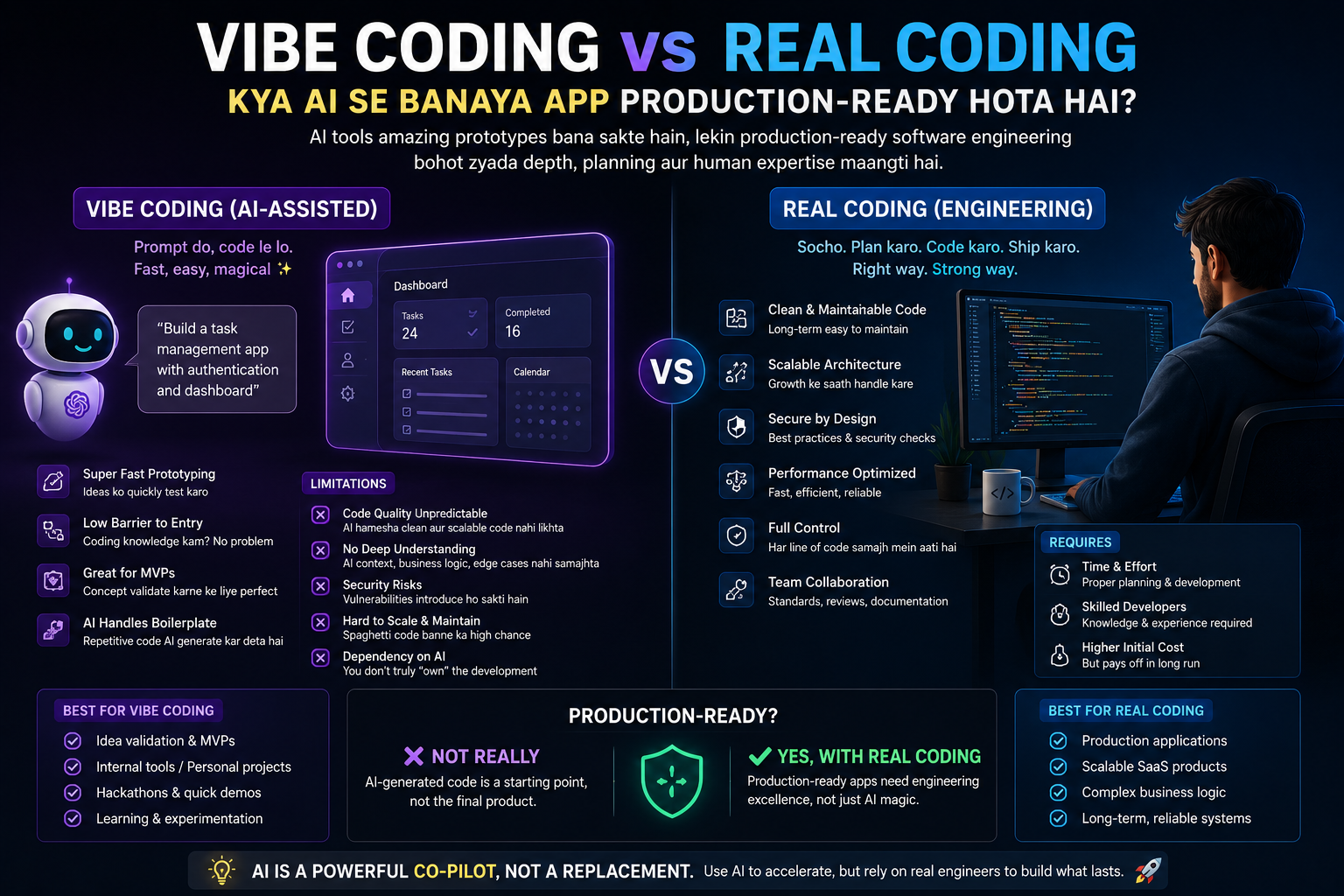
The tech world is buzzing with the concept of 'Vibe Coding'—building applications simply by giving prompts to AI. But is an AI-generated app truly ready for production? We explore the realities of software engineering versus AI prototyping.
The technology industry is currently experiencing a massive shift in how applications are conceptualized and built. A new term has emerged in developer circles: "Vibe Coding." This refers to the process of building software simply by interacting with an artificial intelligence model, relying on natural language prompts to generate functionality. You provide the "vibes" or the overarching idea, and the artificial intelligence outputs the code. It feels like magic, and for many non-technical founders, it represents an unprecedented opportunity to bring ideas to life without hiring an expensive engineering team.
However, this phenomenon raises a critical and highly debated question: Is an application built entirely by artificial intelligence truly production-ready? Or, as the title asks, "Kya AI Se Banaya App Production-Ready Hota Hai?" To answer this, we must critically examine the fundamental differences between Vibe Coding and real software engineering, understanding what happens under the surface when an application scales from a prototype to a business-critical system.
Understanding the Appeal of Vibe Coding
The appeal of Vibe Coding is undeniable. Historically, building a software application required months of specialized learning or a significant financial investment to hire a team of developers. Today, a person with a clear vision can sit down with a large language model and, through a series of iterative conversations, piece together a functional application in a matter of hours or days.
This approach is incredibly powerful for rapid prototyping. If you need to test a business hypothesis, create an internal tool for a small team, or build a proof-of-concept to show investors, Vibe Coding removes the traditional barriers to entry. It democratizes the creation process, allowing domain experts—people who understand the business problem deeply but lack technical syntax knowledge—to actively participate in building solutions. The artificial intelligence acts as an eager, tireless junior developer, instantly translating plain English into functional code blocks.
The Reality of Real Coding: Software Engineering Beyond Syntax
While Vibe Coding focuses on the immediate output of code, real coding—or more accurately, software engineering—is about designing systems that endure. Writing code is actually the easiest part of a software engineer's job. The true value of an engineering team lies in architectural design, edge-case management, security implementation, and anticipating how a system will behave under stress.
Real coding involves understanding the trade-offs between different database structures. It means knowing how to manage memory efficiently so the server does not crash when traffic spikes. It requires planning a testing strategy to ensure that a new feature does not break existing functionality. When you engage in real coding, you are not just building a product that works today; you are building a foundation that can be maintained and scaled over the next five years. Artificial intelligence models, in their current state, are excellent at producing isolated snippets of logic, but they struggle with maintaining the broader architectural context of a massive, interconnected system.
The Gap Between a Prototype and a Production-Ready Application
To determine if an AI-generated app is production-ready, we must define what "production-ready" actually means. A production-ready application is one that can handle real users, real data, and real-world unpredictability without failing. It must be secure, scalable, maintainable, and legally compliant. When we evaluate Vibe Coding against these strict criteria, the gaps begin to show.
An application generated entirely by artificial intelligence might look perfect on the surface. You click a button, and the desired action occurs. However, beneath that user interface, the code might be highly inefficient. The AI might have chosen a suboptimal way to query the database, leading to slow load times. It might have hardcoded sensitive configuration details, exposing your application to security risks. A prototype proves that an idea is possible; a production-ready application guarantees that the idea is stable.
Evaluating Scalability and Performance
Scalability is the first major hurdle for an AI-generated application. When you have ten users testing your app, almost any code structure will perform adequately. When you have ten thousand users trying to access the database simultaneously, poor architectural choices will cause the entire system to collapse.
Artificial intelligence models are trained on vast amounts of open-source code, which means they often suggest the most common or straightforward solution to a problem. However, the most common solution is rarely the most optimized solution for a high-traffic environment. Real engineers spend significant time optimizing database indexes, implementing caching layers, and designing asynchronous background processing queues. An AI simply generating code based on a prompt will likely bypass these complex, invisible optimization layers, resulting in an application that works perfectly until the exact moment your business starts to succeed.
The Critical Issue of Security and Vulnerabilities
Security is non-negotiable in a production environment. If you are handling user data, processing payments, or storing proprietary information, a single vulnerability can destroy your business reputation overnight. This is perhaps the most dangerous aspect of relying purely on Vibe Coding.
When you build an app by prompting an AI, you are deploying code that you do not fundamentally understand. If the AI introduces a vulnerability—such as failing to sanitize user inputs, leading to a SQL injection risk, or improperly configuring authentication mechanisms—you will not realize it until an attacker exploits it. Human engineers conduct code reviews, run automated security scans, and actively monitor for unusual patterns. AI models can assist in identifying security flaws, but relying on them to architect a secure system from the ground up without human verification is incredibly risky.
Maintainability and the Cost of Technical Debt
In the software industry, there is a concept called "technical debt." This refers to the implied cost of additional rework caused by choosing a fast, easy solution now instead of using a better approach that would take longer. Vibe Coding is essentially a machine for generating technical debt.
Because AI models generate code sequentially based on immediate prompts, the resulting codebase often lacks a cohesive structure. It can become a tangled web of functions that solve immediate problems but do not align with a central design pattern. Six months later, when you want to add a new feature, you will find that the codebase is incredibly fragile. Making a change in one area might cause unpredictable breakages in another. True software engineering emphasizes modularity, separation of concerns, and extensive documentation, ensuring that the application remains maintainable even as the original development team moves on.
Handling Customization and Complex Business Logic
AI models excel at generating boilerplate code—the standard structural elements that every application needs, like user login screens or basic data tables. However, business value is rarely derived from boilerplate code. The true value of your application lies in its unique business logic—the complex, proprietary rules that differentiate your product from competitors.
When you attempt to articulate highly complex, deeply nuanced business rules to an AI, the limitations of Vibe Coding become apparent. The model may struggle to hold the entire context in its memory, leading to hallucinations or logical contradictions in the code. A human engineer can understand the business context, ask clarifying questions, and design a logical architecture that perfectly mirrors the real-world operational requirements. AI is a fantastic tool for generating the foundation, but human ingenuity is required to build the unique architecture on top of it.
The Hybrid Approach: AI as an Assistant, Not a Replacement
Does this mean Vibe Coding has no place in professional development? Absolutely not. The most effective engineering teams in the world are rapidly integrating AI into their workflows. However, they are not using it to replace engineers; they are using it to augment them.
In a professional environment, AI acts as a sophisticated assistant. An engineer dictates the high-level architecture, designs the database schema, and establishes the security protocols. They then use AI to rapidly generate the repetitive parts of the code, write unit tests, or quickly research syntax for a new framework. The engineer remains fully responsible for reviewing, testing, and integrating the AI-generated code. This hybrid approach combines the unprecedented speed of Vibe Coding with the structural integrity and security of real software engineering.
Conclusion: Is an AI-Generated App Ready for Production?
Returning to the central question: Kya AI Se Banaya App Production-Ready Hota Hai? The honest answer is no. An application built entirely through Vibe Coding, without rigorous human oversight, architectural planning, and security auditing, is a prototype, not a product.
If your goal is to build a quick internal tool or validate a concept, Vibe Coding is a revolutionary capability. But if you intend to launch a product that handles sensitive data, processes financial transactions, or needs to scale to thousands of users reliably, you must transition from Vibe Coding to real engineering. Artificial intelligence will undoubtedly make development faster, cheaper, and more accessible, but the fundamental principles of software engineering—security, scalability, and maintainability—remain exclusively human responsibilities.
About NovaEdge Digital Labs
NovaEdge Digital Labs is a team of designers, developers, and strategists dedicated to pushing the boundaries of digital innovation in 2026.
Learn more about the team