Top Web Development Trends 2026 for Indian Businesses: Preparing for an AI-First, Performance-Driven Future
NovaEdge Digital Labs
Lead Strategist
Explore the top web development trends of 2026 for Indian businesses — AI-first architecture, Islands Architecture, GEO, and AEO — and how to leverage them for growth.
The digital economy in India is undergoing a massive transformation as we approach 2026. With over a billion internet users and a rapidly expanding middle class across Tier 2 and Tier 3 cities, the expectations for digital experiences have never been higher. Consumers no longer tolerate slow loading times, generic content, or clunky interfaces. They expect websites to be instantly responsive, highly personalized, and intelligent enough to anticipate their needs. For Indian businesses—whether you are running a retail platform, a financial technology service, or a healthcare portal—adapting to these rising standards is critical for survival and sustainable growth.
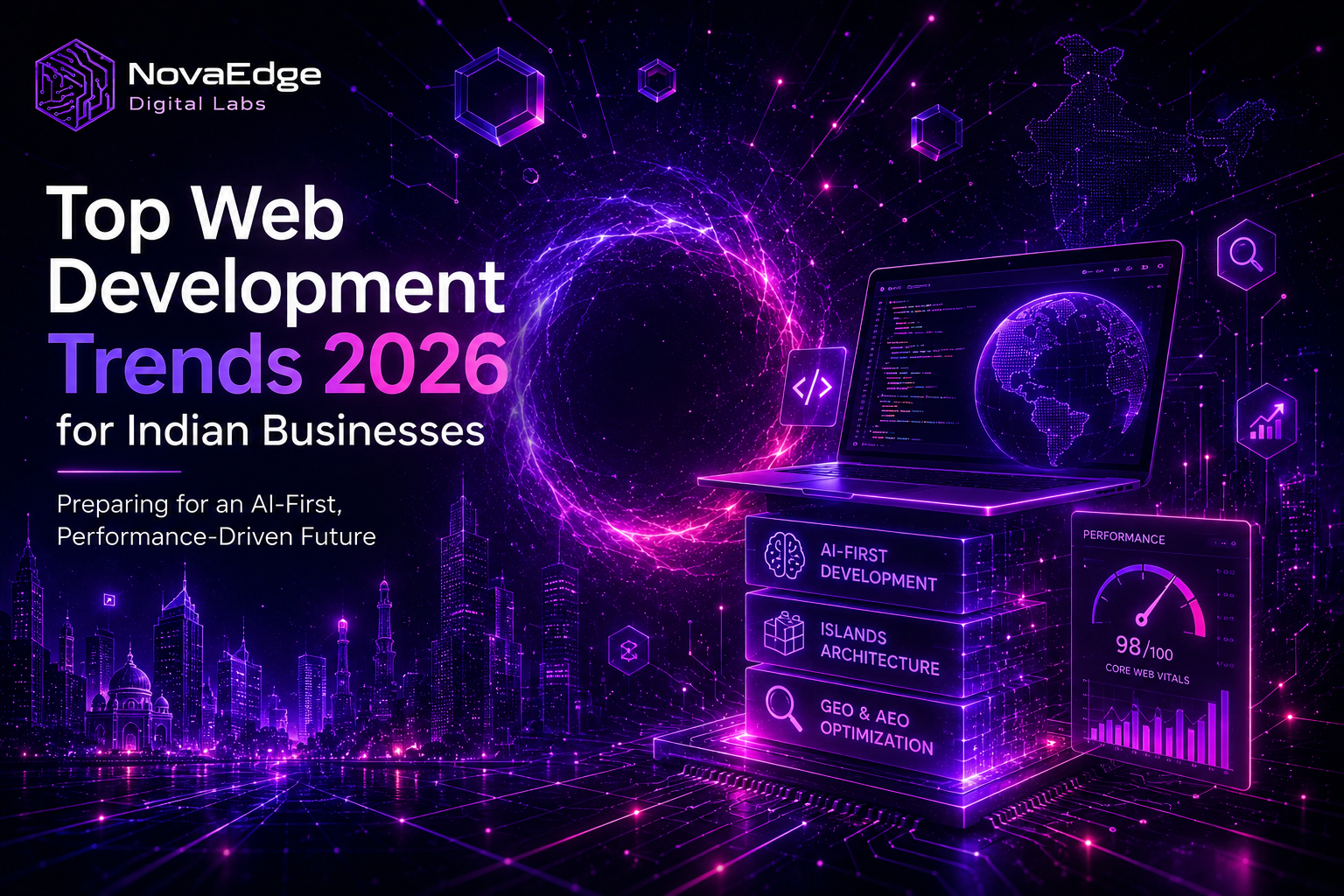
The web development landscape has shifted dramatically to meet these evolving demands. The technical practices and frameworks that worked just a few years ago are now insufficient. In 2026, successful web development is defined by three major pillars: AI-first development, performance-centric design through Islands Architecture, and the evolution of search via Generative Engine Optimization (GEO) and Answer Engine Optimization (AEO). These are not merely industry buzzwords; they represent fundamental changes in how digital products are built, delivered, and discovered in a competitive market.
This comprehensive guide will explore these three critical trends, explaining what they mean, why they matter specifically in the Indian context, and how your business can leverage them to gain a definitive competitive advantage.
1. The Transition to AI-First Development
For a long time, artificial intelligence in web development was treated as an optional add-on. Businesses would build a traditional website and then attach a third-party chatbot or a basic product recommendation widget. In 2026, this fragmented approach is outdated. The industry has moved firmly toward AI-first development, meaning that machine learning models and intelligent logic are woven into the very fabric of the web application's architecture from the ground up.
Understanding AI-First Architecture
An AI-first web application uses artificial intelligence to drive core functionality, dictate the user interface, and manage data flow smoothly. Instead of presenting a static, uniform page to every visitor, the website acts as a dynamic, living entity. It analyzes user behavior, contextual signals, and historical data in real-time to generate a unique experience for each individual. The logic governing what the user sees is determined by sophisticated algorithms rather than hardcoded rules.
Hyper-Personalization in the Indian Market
India is a market of immense diversity, characterized by multiple languages, varying purchasing behaviors, and distinct cultural preferences across states. An AI-first approach allows businesses to navigate this complexity effectively and automatically.
Consider an e-commerce platform built with an AI-first architecture. It can automatically adjust its entire layout, language, and product offerings based on the user's location and browsing history. If a user from Chennai frequently purchases traditional clothing and prefers regional language support, the site will not only highlight relevant products but might also adapt its promotional messaging and interface language automatically upon their next visit.
Similarly, in the rapidly growing educational technology sector in India, AI-first platforms can dynamically adjust course material difficulty based on a student's real-time performance. If a student struggles with a specific math concept, the web application generates supplementary interactive visual aids on the fly, creating a highly customized learning path.
Technical Considerations for Engineering Teams
Transitioning to an AI-first model requires a significant shift in how engineering teams operate. Developers must adopt API-first designs that allow for continuous, low-latency communication with large language models and proprietary machine learning systems. This involves designing flexible, decoupled data structures and ensuring that the frontend can gracefully handle varying, dynamic responses from AI services.
Additionally, Indian businesses must navigate the complexities of data privacy, particularly concerning the Digital Personal Data Protection (DPDP) Act. AI-first systems require significant amounts of user data to function optimally. Therefore, making robust data governance, secure processing, and transparent, user-friendly consent mechanisms non-negotiable components of your web development strategy is essential. Privacy by design must be a core principle, ensuring user trust is maintained while leveraging advanced capabilities.
2. Mastering Performance with Islands Architecture
No matter how intelligent your website is, it will fail to retain users if it is slow. Performance has always been a cornerstone of web development, but the metrics and methods have evolved significantly. In 2026, the standard for performance optimization is Islands Architecture.
The Problem with Traditional Frameworks
Over the past decade, Single Page Applications (SPAs) built with popular JavaScript frameworks became the industry standard. While SPAs provide swift transitions between pages once loaded, they suffer from a major drawback: they require the browser to download, parse, and execute massive amounts of JavaScript before the page becomes fully interactive.
In India, where users frequently access the internet via mobile networks that can fluctuate in speed and reliability—especially outside major metropolitan areas—this heavy reliance on client-side JavaScript leads to poor user experiences. Visitors are left staring at blank screens or unresponsive buttons while the underlying code loads. This negatively impacts critical Core Web Vitals, specifically Largest Contentful Paint (LCP) and Interaction to Next Paint (INP), directly leading to high bounce rates and lost revenue.
The Concept of Islands Architecture
Islands Architecture offers a highly effective, practical solution to this problem. To understand the concept, imagine a web page as a vast ocean of static, lightweight HTML. Within this static ocean, there are isolated "islands" of interactivity powered by JavaScript.
Instead of making the entire page interactive at once, Islands Architecture allows developers to render the bulk of the content statically on the server. The browser only downloads the specific JavaScript needed for the interactive components—like an image carousel, a dynamic EMI calculator for a financial tech site, or an "Add to Cart" button. The rest of the page remains static and loads almost instantaneously.
Why Your Business Needs Islands Architecture
The adoption of frameworks that support this architecture, such as Astro and the latest iterations of Next.js, is accelerating rapidly. For Indian businesses, the benefits are clear, measurable, and directly impact the bottom line. By drastically reducing the amount of code sent to the user's device, your website loads significantly faster across all network conditions and device types, from high-end smartphones in Mumbai to budget devices in rural areas.
Furthermore, faster loading times and improved Core Web Vitals are strong positive signals for search engines, providing an indirect but substantial boost to your organic visibility. Transitioning to Islands Architecture is no longer just a technical upgrade; it is a strategic investment in customer retention and operational efficiency.
3. Generative Engine Optimization (GEO) and Answer Engine Optimization (AEO)
The way users search for information has undergone a paradigm shift. Traditional search engines, where users type a short query and sift through pages of blue links, are being supplemented and often replaced by AI-driven answer engines and generative AI tools. Users now ask complex, conversational questions and expect direct, synthesized answers immediately. This shift has birthed two crucial new disciplines for digital marketers and developers: Generative Engine Optimization (GEO) and Answer Engine Optimization (AEO).
Defining GEO and AEO
While traditional Search Engine Optimization (SEO) focuses heavily on ranking web pages based on keyword density and the volume of backlinks, GEO and AEO focus on ensuring your brand and content are accurately understood, extracted, and cited by artificial intelligence models.
When a user asks an AI tool, "Which is the best cloud-based inventory management software for small retail businesses in India?", the AI synthesizes information from authoritative sources across the web to formulate a narrative answer. GEO and AEO represent the technical and content strategies you employ to ensure your business is the one the AI references, cites, and recommends to the user.
Moving Beyond Keywords to Entities and Context
To optimize for answer engines, developers and content creators must fundamentally change their approach. AI models do not care about how many times a keyword appears on a page; they care about entities, relationships, factual accuracy, and context.
Your web development team must prioritize extremely clean, semantic HTML. The structure of your site must clearly delineate headings, paragraphs, tables, and lists so that automated AI crawlers can parse the information without ambiguity.
More importantly, the robust implementation of Schema.org structured data is absolutely essential. Whether you are defining a LocalBusiness, a SoftwareApplication, a Product, or an FAQPage, structured data acts as a direct translation layer. It feeds precise, categorized facts directly into the knowledge graphs that power large language models, removing any guesswork for the AI.
Creating Content for Answer Engines
Your content strategy must also adapt to this new reality. Indian businesses need to anticipate the direct, specific questions their target audience is asking and provide clear, authoritative, and concise answers on their websites.
If you are a financial services firm, having a page that clearly defines "How the new tax regime affects freelance software developers in India" with structured, easily digestible bullet points increases the likelihood that an AI model will extract your content to answer a user's prompt directly.
Furthermore, establishing brand authority through external mentions and high-quality digital PR remains crucial, as AI models weigh the credibility and consensus of the sources they pull from. In 2026, search visibility depends heavily on being the most reliable, clearly structured, and easily accessible source of truth in your specific industry.
4. The Convergence: Building the Ultimate Digital Experience
The true power of these 2026 trends lies in their combination. AI-first development, Islands Architecture, and GEO/AEO are not isolated strategies to be tackled by different departments; they are interconnected components of a cohesive, modern digital presence.
Consider a modern Indian healthcare network aiming to capture market share and improve patient outcomes.
By integrating these three pillars, the business creates a frictionless, intelligent, and highly visible digital experience that drives growth, builds trust, and establishes market leadership.
Conclusion: Preparing for the Future Today
The year 2026 marks a clear departure from the web development practices of the past decade. The standards for speed, intelligence, and discoverability have been permanently elevated. For Indian businesses, the mandate is clear: you must build for a user base that demands instant performance and highly personalized interactions, while simultaneously ensuring your brand is visible to the AI models that increasingly govern information discovery and decision-making.
Adopting an AI-first architecture, leveraging the substantial performance benefits of Islands Architecture, and optimizing your data structures for GEO and AEO requires a strategic realignment of your development resources. It requires moving away from bloated JavaScript frameworks and keyword-stuffed content toward clean code, highly structured data, and intelligent backend systems.
Now is the time to audit your current web presence. Engage with your engineering, marketing, and product teams to evaluate your Core Web Vitals, assess your readiness for deep AI integration, and rigorously review how your site data is structured. The businesses that embrace these fundamental technical shifts today will not only survive the transition but will define the digital landscape in India for years to come.
Frequently Asked Questions
About NovaEdge Digital Labs
NovaEdge Digital Labs is a team of designers, developers, and strategists dedicated to pushing the boundaries of digital innovation in 2026.
Learn more about the team