What is a Landing Page and Why Every Business Needs One
Amit Kumar Raikwar
Lead Strategist
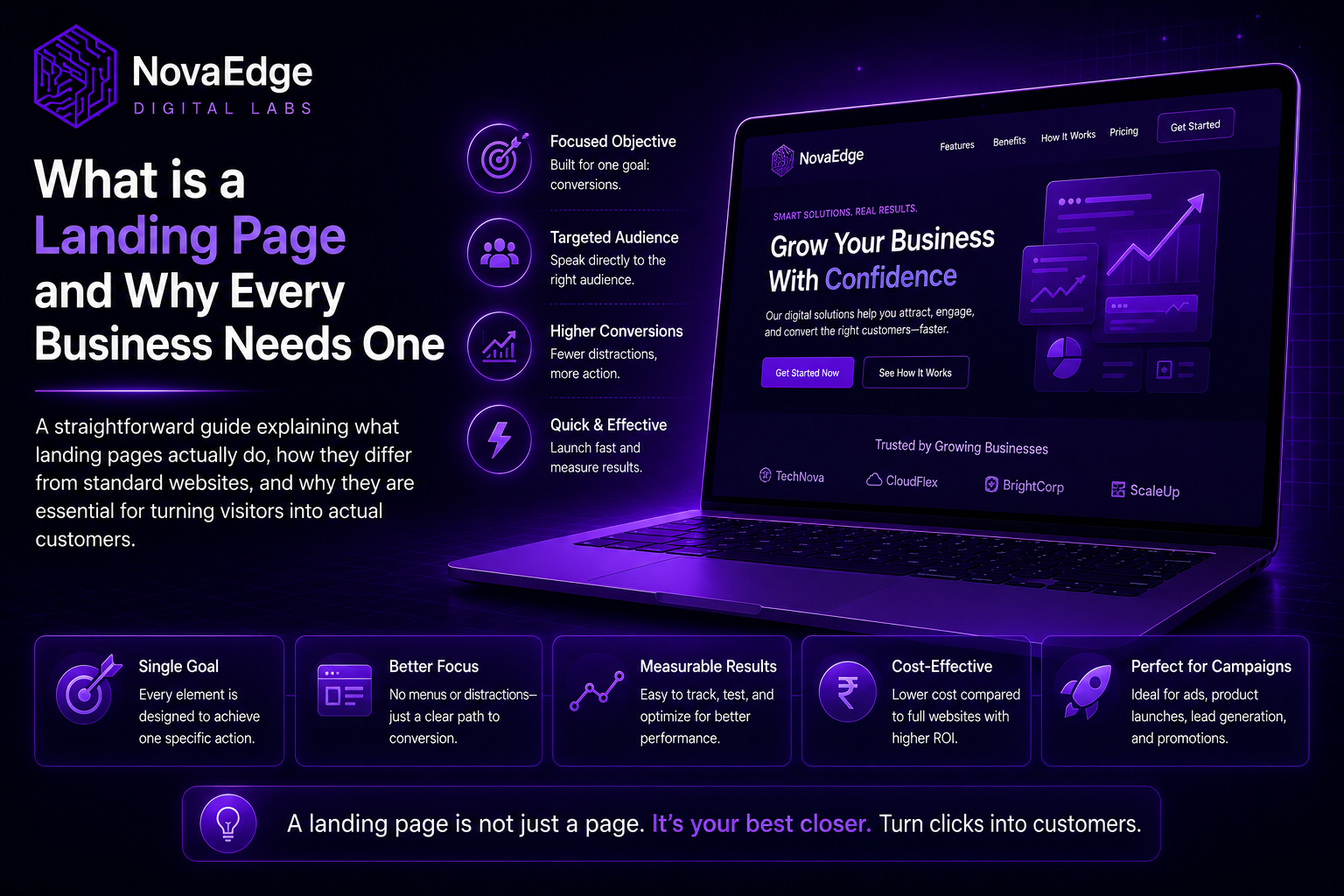
You spend money to bring people to your website, but they leave without taking action. Sound familiar? That is where a landing page comes in. It is a focused, single-purpose webpage designed to do one thing: convert a visitor into a customer or lead. Let us break down why it matters.
Imagine walking into a massive department store. You went in to buy a specific pair of running shoes. But there are no signs, the staff are busy talking about the history of the company, and the shoes are hidden somewhere on the third floor behind the kitchen appliances. What do you do? You walk out.
This is exactly what happens when you run an online advertisement, send out an email campaign, or post on social media, and then send the people who click the link straight to your website's homepage. You are dropping them into a busy department store and hoping they figure out where to go. They usually do not.
That is the problem a landing page solves. It is the digital equivalent of a dedicated salesperson waiting at the door, handing the customer exactly the shoes they came for, and pointing directly to the cash register.
Defining the Landing Page
In practical terms, a landing page is a standalone webpage created specifically for a marketing or advertising campaign. It is where a visitor 'lands' after they click on a link in an email, or an ad on Google, YouTube, Facebook, or similar places.
Unlike regular web pages, which typically have many goals and encourage exploration, landing pages are designed with a single focus or goal, known as a call to action. It is this focus that makes landing pages the best option for increasing the conversion rates of your marketing campaigns and lowering your cost of acquiring a lead or sale.
The Problem with Homepages
Your homepage has a tough job. It has to speak to everyone. It needs to tell investors about your vision, show potential employees your culture, guide returning customers to the login screen, and introduce new visitors to your entire range of products or services. Because it has to do everything, it cannot be highly effective at any single thing.
If a homepage has fifty different links and buttons, that means there are fifty different ways a visitor can get distracted from the one thing you actually want them to do right now. Every extra link is a leak in your bucket.
Landing pages remove those leaks. They typically remove the top navigation bar entirely. There is no 'About Us' link. There is no 'Careers' page link. There is only the offer, the explanation of why the offer is valuable, and the button to claim it. It forces the visitor to make a clear choice: take the action, or leave the page.
Why Your Business Actually Needs One
You might be thinking this sounds like a lot of extra work. Why build a whole new page when you already paid good money for a website? Here is why businesses that rely on digital growth obsess over landing pages.
1. They Make Your Advertising Spend Actually Work
If you are paying for clicks on Google or Facebook, sending that traffic to your homepage is almost always a waste of money. If your ad promises a solution to a specific problem, the page they land on needs to talk exclusively about that problem and that solution. If it does not, the user feels misled or confused, and they hit the back button. That click still cost you money, but it brought zero value. Landing pages align the promise of the ad with the reality of the page, drastically improving your return on investment.
2. They Provide Focus and Clarity
People have short attention spans. When they arrive on a webpage, they want to know immediately if they are in the right place. A landing page tells them exactly what is happening. The headline matches the ad they just clicked. The text is straightforward. The next step is obvious. You are not making them think; you are making it easy for them to act.
3. They Generate Leads More Effectively
Whether you want people to sign up for a newsletter, download a guide, or request a consultation, landing pages are the undisputed champion of capturing information. By offering something of value in exchange for their email address, and removing all other distractions, you significantly increase the number of leads you capture.
4. They Are Easy to Test and Improve
Because landing pages have a single goal, it is very easy to measure if they are working. You look at the conversion rate: the percentage of people who visited the page and actually took the action. If the rate is low, you can test changes. You can try a different headline, a different image, or a shorter form. This kind of systematic improvement is incredibly difficult on a complicated homepage, but it is standard practice on a landing page.
The Core Elements of a Functional Landing Page
While there is no single template that works for every situation, the most effective landing pages share a few structural similarities.
First, the headline. It needs to be clear, not clever. It should immediately state the benefit of whatever you are offering. If the visitor reads nothing else, the headline should tell them why they should care.
Second, the supporting copy. This should be easily scannable. Use bullet points to highlight features, but focus primarily on benefits. How does this product or service make the user's life better or easier?
Third, the visual element. This could be a photograph showing the product in use, or a graphic that illustrates the service. The image should support the message, not distract from it.
Fourth, social proof. People hesitate before taking action. They want to know that others have gone before them and had a good experience. Including a brief testimonial, a review rating, or logos of companies you have worked with can significantly lower that hesitation.
Finally, the call to action itself. This is the button they click or the form they fill out. It should stand out visually from the rest of the page. The text on the button should be specific. Instead of a generic 'Submit', use 'Get Your Free Guide' or 'Start Your Trial'.
When You Should Absolutely Use a Landing Page
You do not need a landing page for every single update your company makes, but there are certain scenarios where not having one is a mistake.
If you are running any kind of paid advertising, you need a landing page. Period. Sending paid traffic to a homepage is burning cash.
If you are launching a new product or service, you need a landing page to explain its specific value without it getting lost in your broader company narrative.
If you are offering a lead magnet—like a free consultation, an industry report, or an email course—you need a dedicated page where people can provide their contact information to access it.
Final Thoughts: Removing Friction
At its core, a landing page is about removing friction. Every distraction on a website—every extra link, confusing paragraph, or unnecessary form field—is friction. It slows the user down and gives them a reason to leave.
A good landing page acts like a smooth, clear path. It acknowledges what the user came looking for, confirms they have found it, and makes it incredibly easy for them to take the next step. If your business relies on turning strangers on the internet into actual customers, building that clear path is not optional. It is fundamental.
Frequently Asked Questions
About Amit Kumar Raikwar
NovaEdge Digital Labs is a team of designers, developers, and strategists dedicated to pushing the boundaries of digital innovation in 2026.
Learn more about the team