What Is Loop Engineering? Is Prompt Engineering Dead?
NovaEdge Tech Team
Lead Strategist
Everyone learned to write better prompts. Then the AI models got smarter and started ignoring most of those tricks. A new discipline called Loop Engineering has emerged, and it changes the entire relationship between humans and AI systems. This is not a minor update. It is a fundamental shift in how useful work gets extracted from large language models.
For the past two years, prompt engineering was treated like a golden ticket. Courses were sold on it. Job titles were created around it. LinkedIn profiles were rewritten to include it. The premise was straightforward: if you learned to write the right words in the right order, you could unlock the full potential of any large language model. You could get better answers, more accurate code, and sharper analysis just by phrasing your request in a specific way.
That premise was not wrong. It was simply incomplete. And now, as AI models have grown more capable, the limitations of that approach have become impossible to ignore. A new discipline has started to take shape in the engineering community. It is called Loop Engineering, and it does not replace prompt engineering the way a new phone replaces an old one. It absorbs it. It takes the idea of writing good prompts and places it inside a much larger, much more powerful framework.
Before we declare anything dead or alive, it is worth understanding what has actually changed, why it changed, and what this means for anyone who builds products, writes code, or runs a business that depends on AI.
The Problem with Single-Shot Prompting
The original model of prompt engineering worked like this: you craft a single, carefully worded instruction. You send it to the AI. You receive a response. If the response is not good enough, you rewrite the prompt and try again. The entire skill revolved around getting that one shot right. People developed elaborate templates with role assignments, output format specifications, and constraint lists, all designed to squeeze the best possible answer out of a single interaction.
This approach works reasonably well for simple tasks. If you need a summary of a paragraph, a translation of a sentence, or a list of ideas for a birthday party, a well-written prompt will get you there. But the moment you try to use AI for anything that carries real business weight, the cracks appear immediately. Ask a model to write a complete technical specification, analyze a financial dataset, or debug a complex piece of software using a single prompt, and you will get output that looks confident but falls apart under scrutiny.
The reason is structural. A single prompt forces the model to handle understanding, reasoning, planning, execution, and quality control all in one pass. That is like asking an architect to design a building, pour the foundation, wire the electricity, and inspect the finished structure all in the same afternoon. No matter how talented the architect, the result will be sloppy. Complex work requires stages, checkpoints, and the ability to revisit earlier decisions based on what you learn later.
What Loop Engineering Actually Means
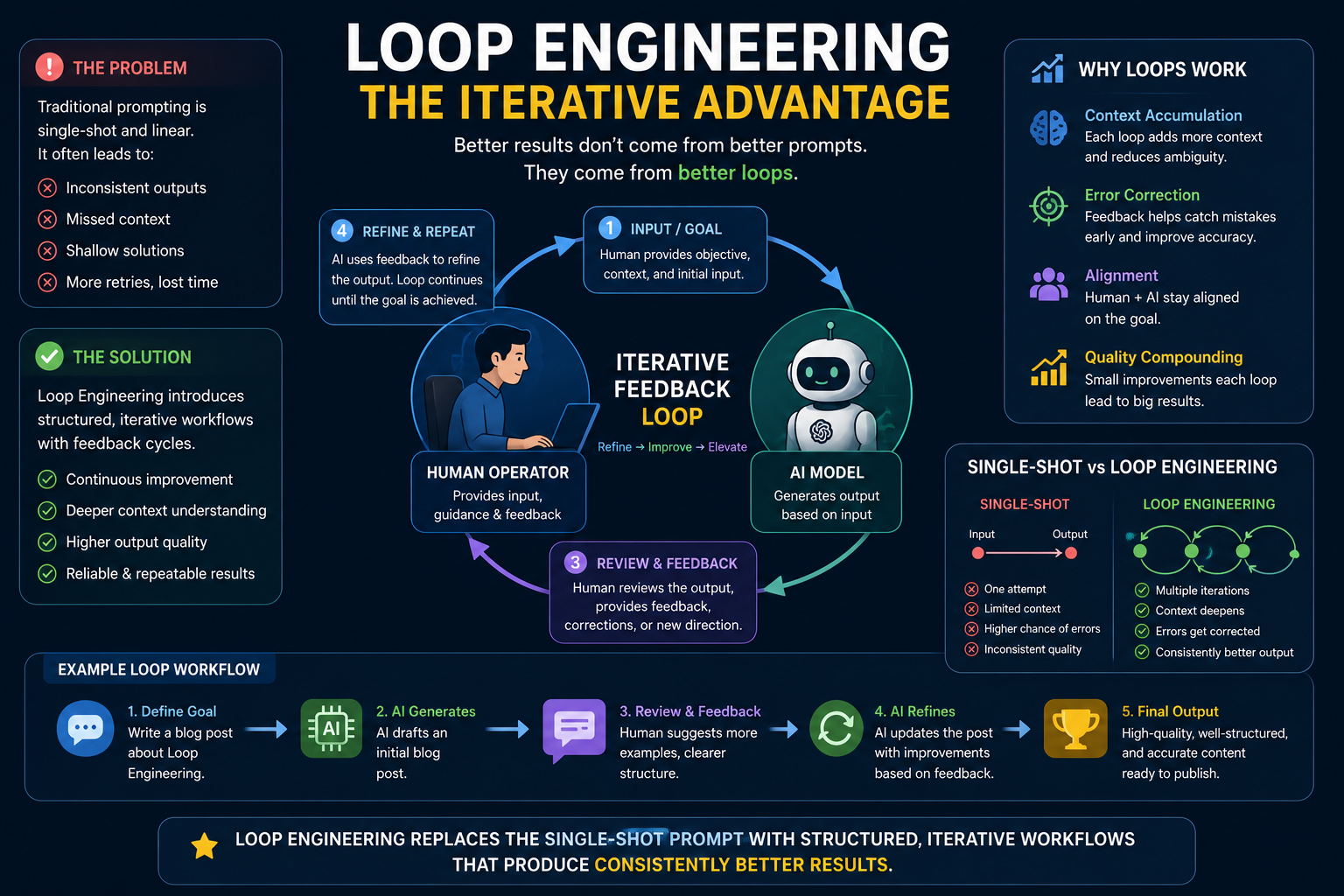
Loop Engineering is not a brand name or a product. It is a way of thinking about how humans and AI systems collaborate on tasks that have real stakes. The core idea is deceptively simple: instead of asking an AI to do everything in one shot, you design a structured sequence of interactions where each step builds on the output of the previous one, and where the model gets the chance to evaluate, correct, and refine its own work.
Think of it as a conversation with a clear agenda. In the first pass, you might ask the model to analyze a problem and identify the key components. In the second pass, you feed that analysis back and ask it to propose a solution for each component separately. In the third pass, you ask it to review its own proposals for logical gaps or contradictions. In the fourth pass, you ask it to synthesize everything into a final deliverable. Each loop narrows the margin of error.
This is not the same as simply sending follow-up messages in a chat window. Loop Engineering involves deliberate structure. You define what each pass is supposed to accomplish. You establish criteria for what counts as a successful output at each stage. And critically, you build in evaluation steps where the model, a second model, or a human operator checks whether the output meets a defined standard before the process continues.
Why the Models Themselves Forced This Shift
There is an irony at the heart of this transition. The better AI models get, the less effective old-school prompt engineering becomes. When models were smaller and less capable, they needed very specific instructions to produce anything useful. You had to tell the model exactly what persona to adopt, what format to use, and what constraints to follow. The model was like a trainee who needed detailed written instructions for every task.
Modern large language models are not trainees anymore. They understand context. They infer intent. Many of the tricks that prompt engineers spent months perfecting, like specifying a persona or adding phrases that signal authority, now make little to no measurable difference in output quality. The models have been trained on enough data to understand what you need from a plainly written request. The marginal value of spending thirty minutes crafting a single elaborate prompt has dropped significantly.
But here is what has not changed: the models still struggle with long, complex, multi-dimensional tasks done in one pass. They are better at each individual step, but they still lose coherence when asked to juggle too many objectives simultaneously. This is precisely where Loop Engineering steps in. It does not try to make the model smarter within a single turn. It gives the model multiple turns to be smart, with structured feedback between each one.
The Anatomy of a Well-Designed Loop
A loop, in this context, has four distinct phases. Understanding these phases is the difference between someone who uses AI casually and someone who builds reliable systems on top of it.
The first phase is decomposition. You take a complex task and break it into discrete, manageable subtasks. If you need the AI to write a market research report, you do not ask for the whole report at once. You ask it to first identify the target market segments. Then, separately, you ask it to gather relevant data points for each segment. Then you ask it to write the analysis. Then you ask it to draft the conclusion. Each subtask is small enough for the model to handle with high accuracy.
The second phase is execution. The model processes each subtask and produces an output. This is where your individual prompts live. They are still important. A badly written prompt will produce a bad output even within a well-designed loop. But the prompt is no longer carrying the full weight of the task. It is responsible only for its own narrow piece.
The third phase is evaluation. This is the part that most people skip, and it is the part that makes Loop Engineering fundamentally different from basic prompting. After the model produces output, something checks that output against a defined standard. That something could be a second AI model acting as a reviewer, a set of automated tests, a scoring rubric, or a human operator. If the output does not meet the standard, it goes back for revision.
The fourth phase is synthesis. Once all subtasks have been completed and validated, the individual pieces are assembled into a final deliverable. This assembly step can also be handled by the AI, but now it is working with verified components rather than trying to produce everything from scratch.
Where This Shows Up in Real Work
Loop Engineering is not a theoretical concept discussed only in academic papers. It is already being used in production environments, and the results are measurably different from what single-shot prompting can deliver.
In software development, agentic coding tools now use loops to write code, run tests against that code, read the error messages, and revise the code automatically. The developer does not write a prompt that says 'write me a function that does X.' Instead, the system runs a loop: generate code, execute it, analyze failures, regenerate the broken parts, and repeat until all tests pass. The developer's job shifts from writing the perfect prompt to defining the test cases and acceptance criteria.
In content production, marketing teams use loops to draft, critique, revise, and format articles. A first pass produces a rough draft. A second pass evaluates it against brand guidelines and factual accuracy standards. A third pass rewrites the sections that failed evaluation. The final output is not the product of a single inspired prompt. It is the product of a structured editorial process that happens to be powered by AI.
In data analysis, loops allow AI to explore a dataset iteratively. The first pass identifies patterns. The second pass tests whether those patterns hold under different conditions. The third pass generates visualizations. The fourth pass writes a summary narrative. Each pass refines the understanding, and the final analysis is far more reliable than anything a single prompt could produce.
So Is Prompt Engineering Actually Dead?
No. But its status has changed permanently. Prompt engineering is no longer a standalone discipline that justifies its own job title. It has become a foundational literacy, similar to how knowing how to write a good email is essential for any office worker but is not, by itself, a career.
If you spent the last two years learning how to write clear, structured instructions for AI models, that knowledge is not wasted. It is still the raw material that every loop is built from. You still need to write good prompts at each stage of a loop. The difference is that the prompt is now one component inside a larger system, not the system itself.
What has died is the idea that a single, perfectly crafted prompt is the ceiling of what you can achieve with AI. That ceiling has been shattered. The people and businesses that will get the most value from AI going forward are not the ones writing the cleverest single prompt. They are the ones designing the smartest workflows, the most rigorous evaluation criteria, and the most effective feedback loops.
What This Means for Developers and Businesses
For developers, the implication is direct. The skill that matters now is systems thinking. You need to be able to break a problem into parts, define success criteria for each part, and design an automated or semi-automated pipeline that moves work through those stages. This is not a new skill for experienced engineers. It is basically what they have been doing for decades, applied to a new type of tool. What is new is that this systems-design skill now applies to tasks that used to be considered non-technical, like writing, analysis, and research.
For businesses, the implication is strategic. If you are evaluating AI tools for your operations, stop asking whether a tool responds well to a single prompt. Start asking whether it supports iterative workflows. Can it run multiple passes on a document? Can you define quality gates? Can it integrate with external verification tools? The AI platforms that will dominate the next phase of this industry are the ones that make Loop Engineering accessible, not just to programmers, but to operations managers, analysts, and content teams.
For individuals who built their identity around prompt engineering, the path forward is clear. Expand. Learn how to design evaluation criteria. Learn how to chain multiple AI interactions into a workflow. Learn the basics of orchestration tools and agent frameworks. The underlying instinct that made someone good at prompt engineering, which is the ability to think clearly about what you want from an AI and how to communicate it, is exactly the instinct that Loop Engineering demands. The scope of application has simply grown larger.
The Transition Is Already Happening
This is not a prediction about some distant future. The shift from single-shot prompting to loop-based workflows is already underway. Major AI labs are releasing tools explicitly designed for multi-step agentic workflows. Code editors now ship with built-in iterative coding agents. Enterprise platforms are building pipeline features that allow non-technical users to construct multi-stage AI processes through visual interfaces.
The organizations that recognize this shift early will build more reliable AI-powered systems, ship higher-quality outputs, and reduce the frustrating inconsistency that plagues single-prompt workflows. The ones that stay stuck on the idea that a better prompt is the answer to every problem will keep getting mediocre results and blaming the model for their limitations.
Loop Engineering is not a rejection of prompt engineering. It is the natural next chapter. The people who wrote the best prompts will write the best loops. But they will need to stop thinking of AI as a vending machine where you insert the right coin and receive the right product. AI, at its most useful, is a collaborator that improves through iteration. Loop Engineering is simply the discipline of making that iteration intentional, structured, and measurable.
Frequently Asked Questions
About NovaEdge Tech Team
NovaEdge Digital Labs is a team of designers, developers, and strategists dedicated to pushing the boundaries of digital innovation in 2026.
Learn more about the team