What is SEO and Why Does Your Business Website Need It?
Amit Kumar Raikwar
Lead Strategist
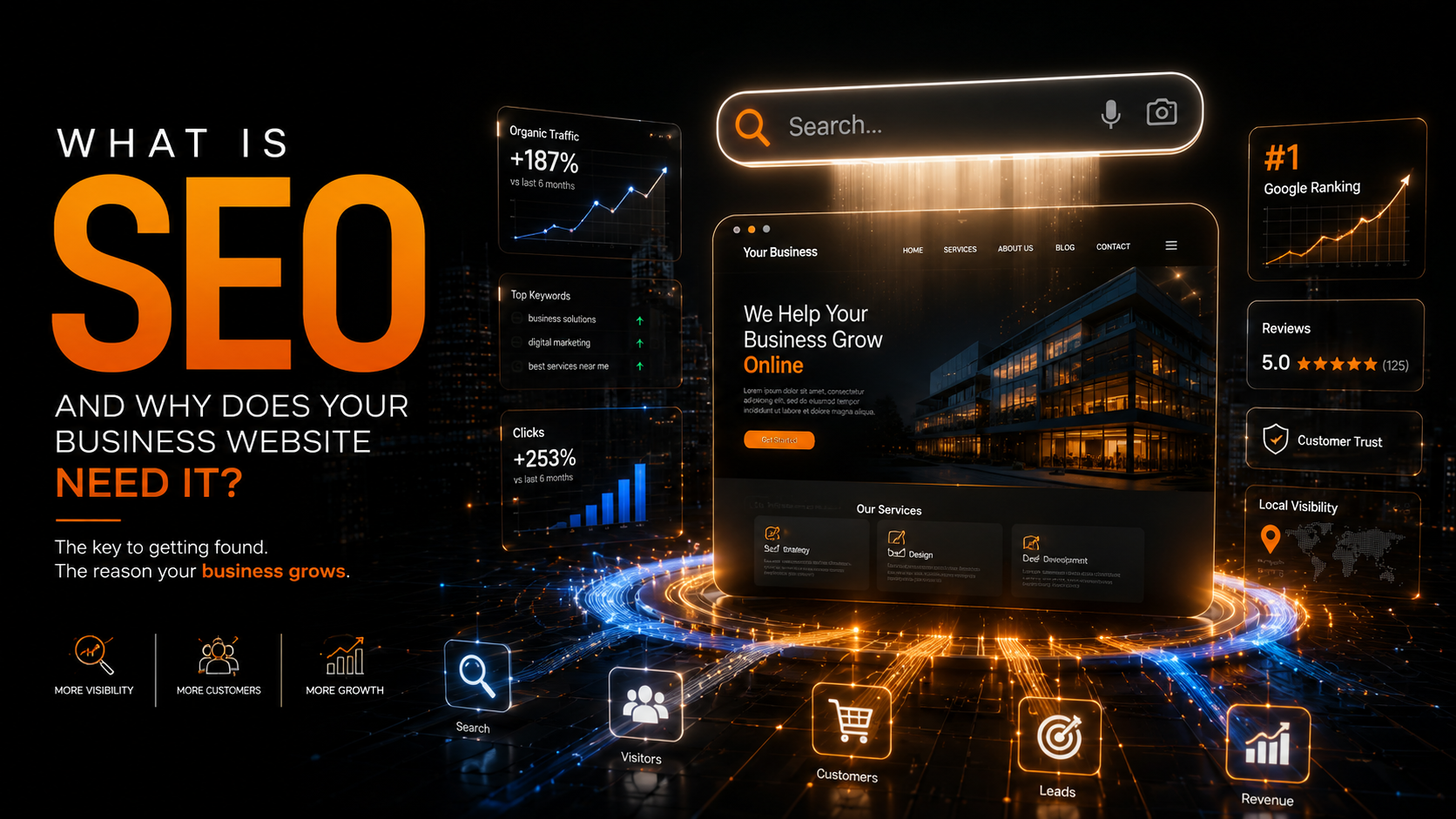
A plain-language breakdown of what SEO really means, how search engines decide which websites to show first, and why ignoring SEO is costing your business real customers every single day.
You built a website for your business. Maybe you spent a decent amount of money on it. The design looks good, the pages load fine, and all the information is there. But weeks pass, and nothing happens. No phone calls. No enquiries. No orders. The website sits there like a shop on a deserted street — well stocked but invisible.
This is the reality for thousands of business websites across India and around the world. They exist, but nobody finds them. The reason is almost always the same: there is no SEO.
SEO — Search Engine Optimization — is the difference between a website that brings in customers and one that collects dust. If you have ever wondered what SEO actually is, why people keep talking about it, and whether your business genuinely needs it, this post will give you a straight answer.
What SEO Actually Means (Without the Jargon)
At its core, SEO is the process of making your website easier for search engines to find, understand, and recommend to people.
When someone types a question or a phrase into Google — say, 'best dentist in Indore' or 'how to file GST returns' — Google does not randomly pick which websites to show. It runs those words through a set of rules and scoring systems to decide which pages are the most relevant, the most trustworthy, and the most useful. The pages that score highest show up at the top of the results. The ones that score low get buried on page four or five, where almost nobody ever looks.
SEO is everything you do to make sure your website scores well in that evaluation. It covers the words on your pages, the technical structure of your site, how fast it loads, whether other reputable websites link to yours, and dozens of other factors.
Think of it this way. Google is like a librarian with access to every book ever written. When someone asks a question, the librarian does not hand over a random pile of books. They pick the ones that best answer the question, are written clearly, and come from authors with a good reputation. SEO is how you make sure your book — your website — is the one the librarian reaches for first.
The Three Pillars of SEO
SEO is not a single activity. It is a combination of three areas that work together. Understanding these will help you see why it requires ongoing attention, not a one-time fix.
1. On-Page SEO: What Your Website Says
This is the content and structure on your actual web pages. It includes the words you use in your headings, paragraphs, and product descriptions. It covers your page titles — the blue links people see in Google search results. It also includes your meta descriptions, image descriptions, and how your URLs are structured.
On-page SEO is about clarity. When Google reads your page, it should immediately understand what the page is about and who it is for. If you run a photography studio in Mumbai and your homepage never mentions photography, Mumbai, or any related terms, Google has no reason to show your site when someone searches for a photographer in Mumbai. It sounds obvious, but a surprising number of business websites fail at this basic step.
2. Technical SEO: How Your Website Works
This is the behind-the-scenes work that most business owners never see but search engines care about deeply. Technical SEO covers how fast your pages load, whether your site works properly on mobile phones, whether Google can actually crawl and index all your pages, and whether your site is secure (using HTTPS instead of HTTP).
A website that takes five seconds to load on a phone will get penalized by Google, no matter how good the content is. A site that is not mobile-friendly will struggle to rank because more than 60 percent of all Google searches now happen on mobile devices. Technical SEO is the foundation. Without it, even the best content will underperform.
We wrote about how website design quality directly affects business outcomes in our post on why a well-designed website matters for businesses — and technical SEO is a major part of that equation.
3. Off-Page SEO: What Others Say About Your Website
Off-page SEO is about your website's reputation across the internet. The most important factor here is backlinks — when other websites link to yours. Each backlink acts like a vote of confidence. When a respected industry blog, a news outlet, or a government website links to your page, Google sees that as a signal that your content is trustworthy and worth recommending.
Off-page SEO also includes your presence on business directories, social media mentions, and online reviews. The more credible references to your business that exist across the web, the more authority Google assigns to your site.
Why Your Business Website Needs SEO
If you are still wondering whether SEO is worth the effort, consider what happens without it.
Your Competitors Are Already Doing It
Search results are a zero-sum game. There are only ten organic spots on the first page of Google. If your competitor's website occupies those spots and yours does not, every potential customer searching for your type of business sees them instead of you. They get the call. They get the order. You get nothing — not because your product is worse, but because your website is invisible.
People Trust Organic Results More Than Ads
Research consistently shows that the majority of users scroll past paid ads and click on organic results instead. There is an inherent trust in a website that earns its position at the top versus one that pays for it. When your site ranks organically for a relevant search, people perceive your business as more credible and more established. That trust translates directly into higher click-through rates and more conversions.
SEO Brings in Customers Who Are Already Looking for You
This is the part that makes SEO fundamentally different from most other forms of marketing. When you put up a billboard or run a TV ad, you are interrupting people who may or may not care about your product. SEO works the other way around. It puts your website in front of people who have already typed a question or a need into a search engine. They are actively looking for what you sell. They have intent. That makes SEO traffic some of the highest-converting traffic any business can get.
It Costs Less Than Advertising in the Long Run
Google Ads work, but they operate on a pay-per-click model. Every visitor costs you money. The moment you stop paying, the traffic stops. SEO requires an upfront investment of time and resources, but once your pages rank well, they continue to bring in visitors for months or even years without any additional cost per click. Over time, the cost per lead from SEO drops dramatically compared to paid advertising.
For small businesses and startups with tight budgets, this makes SEO one of the most efficient investments available. We covered how Indian small businesses are finding cost-effective ways to grow using technology in our post on how small businesses in India use AI to save money — and SEO follows the same principle of investing wisely for compounding returns.
It Builds Your Brand Authority Over Time
When your website consistently appears in search results for topics related to your industry, people start recognizing your name. Even if they do not click today, seeing your business appear again and again builds familiarity. Familiarity builds trust. Trust builds preference. This is how small, unknown companies gradually become the go-to name in their space — not through flashy ad campaigns, but through persistent, visible presence where it matters most.
Common SEO Mistakes Business Owners Make
Knowing what SEO is and knowing how to do it right are two different things. Here are the mistakes we see most often.
- Treating SEO as a one-time task. SEO is not something you set up once and forget. Search engines update their rules constantly, competitors adjust their strategies, and your content needs to stay fresh and relevant. It requires consistent, ongoing attention.
- Stuffing pages with keywords. Writing 'best dentist Indore best dentist Indore best dentist' fifteen times on a page does not work. Google's algorithms are sophisticated enough to detect keyword stuffing, and they will penalize your site for it. Write for humans first, search engines second.
- Ignoring mobile users. If your website is not easy to use on a phone, you are losing more than half your potential audience. Google explicitly prioritizes mobile-friendly websites in its rankings.
- Skipping page titles and meta descriptions. These are the first things people see in search results. A vague or missing title means fewer clicks, which means lower rankings. Every page on your site needs a clear, specific title and a compelling description.
- Publishing thin or duplicated content. Pages with only a few sentences, or content copied from other websites, signal low quality to Google. Your content needs to be original, substantial, and genuinely useful to the reader.
How to Start With SEO if You Have Never Done It Before
You do not need to become an SEO expert overnight. Start with the fundamentals and build from there.
First, make sure every page on your website has a clear, descriptive title that tells both Google and visitors what the page is about. Second, write content that directly answers the questions your customers are asking. If you run an accounting firm, write a detailed page explaining how GST filing works. If you sell handmade furniture, create content about how to choose the right wood for a dining table. Real, useful information attracts real visitors.
Third, claim your Google Business Profile. For any business that serves a local area, this is one of the single most impactful things you can do. It puts your business on Google Maps and in local search results, complete with your address, phone number, hours, and customer reviews.
Fourth, check your website speed. Use Google PageSpeed Insights — it is free — and fix whatever it flags. Slow pages drive visitors away and hurt your rankings.
Fifth, start building links. Reach out to local business directories, industry associations, and partners who might be willing to link to your website. Every credible link is a vote of confidence in Google's eyes.
SEO Is Not Optional Anymore
Ten years ago, a business could survive with a basic website and rely on word of mouth, foot traffic, or print advertising. That world is fading fast. Today, the first thing most people do when they need a product or service is pull out their phone and search for it. If your business does not show up in that search, you do not exist in that moment.
SEO is not a luxury. It is not a technical curiosity reserved for tech companies. It is a fundamental requirement for any business that wants to be found by the people who are already looking for it. Whether you run a restaurant in Jaipur, a law firm in Delhi, a clothing brand in Surat, or a software company in Indore, SEO is the bridge between your website and your next customer.
The businesses that invest in SEO today will own the search results tomorrow. The ones that ignore it will keep wondering why their website is not bringing in any business.
At NovaEdge Digital Labs, we help businesses build websites that people actually find. Our SEO work is grounded in real data, honest strategy, and a focus on results that matter — more traffic, more enquiries, more revenue. If your website is not pulling its weight, let us take a look and tell you exactly what needs to change. No fluff, no buzzwords — just a clear plan to get your business visible where it counts.
Frequently Asked Questions
About Amit Kumar Raikwar
NovaEdge Digital Labs is a team of designers, developers, and strategists dedicated to pushing the boundaries of digital innovation in 2026.
Learn more about the team